
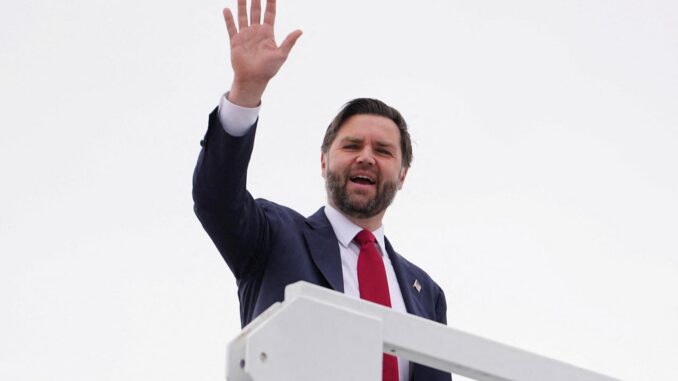
After weeks of working in the shadows and little media exposure, the vice president J.D. Vance has decided to take a step forward regarding the war in Iran and take charge of the negotiations with the Iranian leaders in person.
Vance, a veteran of the Iraq War, has based much of his political prestige on opposition to US intervention in foreign conflicts, always criticizing his allies, especially the Europeans, for their sloppiness and lack of commitment.
The decision to send Vance to collaborate with the ubiquitous Steve Witkoff y Jared Kushner It is intended to show the Iranian regime that the United States is serious about the negotiations by adding such a high profile.
The Iranians, for their part, seem delighted: they understand that Vance will accept almost anything to get his country out of the war and avoid an escalation that could cause casualties among US troops and an electoral disaster for the Republican Party in November.
Such escalation can also obviously take precedence over Vance’s own electoral aspirations for 2028, when he will probably have to face Marco Rubio for the nomination.
Now, the vice president’s position is very uncomfortable: he has to reach an agreement with leaders who do not know if they have the support of the ayatollah. Ali Jamenei on the terms that Trump demands, without taking into account his personal wishes, but rather the position previously established by the other White House negotiators.
Tense conversation with Bibi
Vance was from the beginning opposed to intervention in Iran, but, once they were in trouble, he defended a military action so forceful that it would cause the regime to surrender as soon as possible.
Here you will find a middle ground that, in principle, is the one that least fits with your way of seeing things: as long as you negotiate with Iran – and it must be insisted that we still do not know exactly with whom you are negotiating – the Strait of Hormuz will remain closed, the conflict will stagnate, the world economy will pay the price and the possibilities of military action will grow.
The vice president is also very angry with Israel, the United States’ partner in this adventure.
According to the digital AxiosVance had a tense conversation this week with Benjamin Netanyahu in which he accused him of having excessively “softened” to Trump the possibility of a regime change in Tehran, something that has proven to be really complicated.
Blaming Israel can serve as a response to certain public opinion led by Tucker Carlson and that sector of the MAGA movement, but it is obvious that Trump has gotten into this mess by himself, aware of all the dangers it entailed – we are talking about a man with more than five years of experience in the White House, let’s stop treating him as a newcomer – and that he has had other countries around him that have put pressure on the same as Israel: Saudi Arabia and the United Arab Emirates, mainly.
Back to 2015?
The issue, at this point, is not only with whom Vance is going to negotiate, since its president has been saying for four weeks that the Iranian regime has been completely beheaded – he has also repeatedly insisted that its military infrastructure had been annihilated, but the Pentagon had to acknowledge this Friday that only a third of Iranian weapons have been eliminated – but exactly what he is going to negotiate and what results he hopes to obtain.
If the conversation turns to the famous “fifteen points” that Trump pulled out of his sleeve last Monday, Vance can save himself the trips and calls.
Iran is aware of its military inferiority, but it is going to cling to what has worked perfectly for it: the threat to neighboring countries, the impact that this can have on the world economy and inflation in the United States… and the fact that it can decide at will when to open and close Hormuz to the navigation of various oil tankers and cargo ships.
In that sense, thinking about a negotiated surrender seems excessively optimistic.
The United States, with or without Vance leading its diplomatic delegation, can return to the agreement Barack Obama of 2015 – from which Trump himself left in 2018 because he considered it useless -, achieve some type of minimally satisfactory trade agreement or even establish limits on the production of Iranian ballistic missiles, as Israel demands.
Now, for that, it wouldn’t have been worth getting into this mess.
“Two or four more weeks of war”
The most likely thing, taking into account, furthermore, that the Arab countries and Israel continue to bet on regime change, and that it is not ruled out that Netanyahu will continue with his operation ‘Roar of the Lion’ even if Trump abandons his ‘Epic Fury’, is that the United States will end up realizing that its objectives are impossible to achieve through diplomatic means and will return to the military path.
The problem there, apart from the obvious risk that it would entail not only to conquer, but to later defend, loose positions along the Gulf, is that, at the same time that Trump gains time to perfect this massive attack, Iran also gains time to prepare.
That does not mean that it is in a position to militarily stop the largest army in the world… but it can organize retaliation and look for ways to harm the United States and its partners with all the resources at its disposal.
Marco Rubio He explained this Friday to the foreign ministers of the G7 countries that the war could last between two and four more weeks and that the United States was not willing to give up on any of its objectives.
Since we don’t know what they are, beyond the guarantee that Iran will never have a nuclear weapon, something that was promised to Obama eleven years ago, it seems like a somewhat empty statement.
In any case, the markets seem to have taken note: unlike on other occasions, the promise of a negotiation has been received with skepticism: the barrel of Brent was once again above $110 and for fourteen of the last fifteen days the price has exceeded $100, something that, in the medium and long term, is unsustainable… no matter how much Trump stated this Friday that he “expected it to rise even more.”
Leave a Reply