
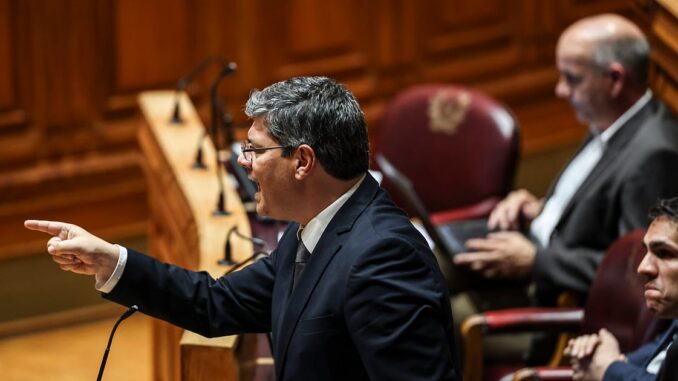
The Portuguese Communist Party’s question to the Government about the rise in prices, following the war in the Middle East, ended up this Wednesday (25 March) going beyond the central theme and turning into a cross debate on foreign policy, ideological coherence and past responsibilities, with the visits of José Luís Carneiro to Venezuela and André Ventura to the Hungarian Prime Minister Viktor Orbán deserving attacks and counter-attacks in the hemicycle.
The general secretary of the PCP, Paulo Raimundo, opened the debate with harsh criticism of the executive, accusing it of presenting “insufficient” measures that were too focused on taxation. The communist leader defended that “it is urgent to move forward with price regulation”in fuels, energy and basic food baskets, and insisted that the profits of large economic groups must be called upon to bear the impact of the crisis. “The people cannot pay for a war that is not theirs,” he stated.
The communist thesis, which directly associates the rise in prices with the conflict in the Middle East, however, was the target of fierce criticism from the right. In the second part of the debate, André Ventura accused the PCP of now demanding what it ignored when Russia invaded Ukraine in 2022 and of never having clearly condemned Vladimir Putin. “We hear the PCP talk about the US war and Trump as responsible for the inflation and rising cost of living that we are facing. But it ignores the war that had the biggest increase in the food basket ever since World War II. It wasn’t Trump’s, Milei’s, Bolsonaro’s war, it was Mr Putin’s war and which the PCP was never able to condemn”, he shot.
The leader of Chega also took the opportunity to expand the attack on the Socialist Party, criticizing José Luís Carneiro’s recent trip to Venezuela, which he classified as a gesture of support for a “tyrant regime”. Addressing the PS as “the third largest party in parliament” – a fact highlighted three times – “but as one of the great parties of our democracy”, he accused the socialist general secretary of having gone to Venzuela “to lend a hand, a foot and give everything to a tyrannical, murderous, corrupt government”. “That one, we know is on the wrong side of history.”
The response came quickly from Eurico Brilhante Dias, parliamentary leader of the PS, who accused Ventura of inconsistency for criticizing Carneiro’s visit to a country “with one of the largest communities of Portuguese emigrants” and where “there are Portuguese who remain politically detained, political prisoners”, but on the other hand having visited Hungarian Prime Minister Viktor Orbán, “one of the leaders who block European support for Ukraine”. “While we went to Venezuela to take care of the Portuguese community, you went to celebrate the extreme right in Europe with Orbán. You are a collaborator of Putin through collaboration with Orbán. You are a political fraud. Why did you go to visit Orbán?”, he asked, in a question that remained unanswered.
The exchange of accusations between PS and Chega dominated large moments of the debate and led the PSD parliamentary leader, Hugo Soaresregretting that “everything except what interests the Portuguese” was being discussed. Even so, he also pointed the finger at the PCP for not having the same concern about prices during the war in Ukraine and pressured the Chega leader to explain how he would reconcile the proposals for a generalized tax cut with the sustainability of public accounts: “The deputy ended with tolls, with VAT, with all the State’s revenue. How did you maintain roads, the NHS, schools? That’s the big question you don’t have an answer to,” Ventura said.
The moment of tension between the parliamentary leader of the PSD and the president of Chega was interrupted by the president of the Assembly of the Republic, Aguiar Branco, who halted the escalation with advice to “not waste all the energy in the world discussing one more point or one less point in a tax”, especially because “there is more to life than parliament”, eliciting laughter even from those involved. In such a way that Ventura was no longer able to continue with the intervention and considered it closed.
Government available for more measures, but “without mortgaging the future”
On the Government’s side, the line of defense was to highlight the measures already adopted and the need for prudence. The Secretary of State for Economy, João Rui Ferreira assured that Portugal is now “more robust” to face external shocks. He listed support for companies and families and highlighted investment in renewable energy as a guarantee of Portugal’s energy independence. Regarding the opposition’s demands for reinforcement of measures, he defended the need for the Government to be “balanced” so as to “not mortgage the future”.
Also the Secretary of State for Finance, Cláudia Reis Duarte, detailed the reduction in fuel tax, translated into an accumulated drop in the ISP, so far, of 20.8 cents on diesel and 19.3 cents on gasoline. He stressed that the Government is available to adjust measures, but always with “responsibility”.
Even so, the opposition, from left to right, converged on the idea that the response is insufficient and there were several interventions recalling the five billion euro package of exceptional support measures presented by the Spanish government. From PS to Livre, including Chega, calls for more robust measures to mitigate the increase in the cost of living have multiplied. Rui Tavares, from Livre, did not hesitate to criticize Ventura for “having a strong voice about Putin’s war and a thin voice towards Orbán”, but he condemned the deviation of the debate towards side issues and spoke of an “ideological war” similar to “the one we see every day on social networks, on Twitter and Facebook”: “Venezuela here, Orbán there. What about the measures for the Portuguese?”
In response, Hugo Carneiro, from the PSD, recalled that “Portugal was one of the first countries to come forward with the measures” and said that “the opposition arrived late to this debate and is now asking for more hasty ones without explaining how they would be financed”. And he left a final warning: “More expensive measures today mean more taxes or less funding for public services tomorrow.”
Leave a Reply