
The keys
nuevo
Generated with AI
nuevo
Generated with AI
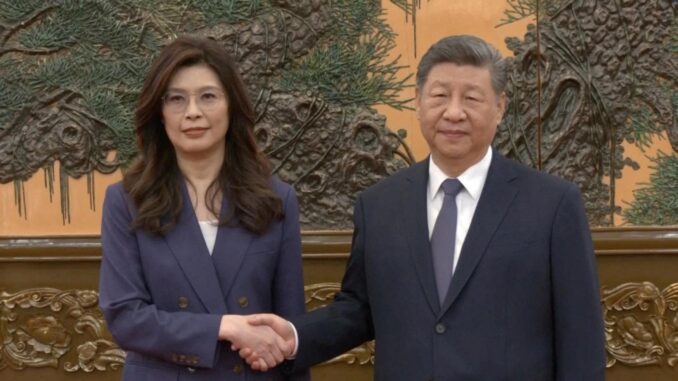
The Chinese president, Xi Jinpingreceived this Friday in Beijing to the leader of the Taiwanese opposition, Cheng Li-wunin the first meeting of this type in almost a decade and in a context marked by the possible visit to the Asian giant of the American president, Donald Trump.
Xi received in Great Hall of the People in Beijing to the president of the Kuomintang (KMT), Taiwan’s main opposition force, and expressed willingness to “strengthen exchanges and dialogue” with all parties, groups and social sectors on the island “to seek peace in the Strait, the well-being of compatriots and the rejuvenation of the Chinese nation.”
“Between members of the same family, as long as things are discussed well and issues are consulted more, there are no differences that cannot be resolved. Differences in the social system should not serve as a pretext for division,” said the Chinese leader, who attended the meeting as general secretary of the Communist Party (CCP).
After the coming to power of Democratic Progressive Party (PDP), with a sovereignist tendency, in 2016, the Government Chinese chose to suspend all official contact with the island Executive and intensified its campaign of political, diplomatic and military pressure on Taiwanwhich it considers as part of its territory.
Since then, Beijing has limited itself to dialogue with representatives of the Kuomintang (in Mandarin, Chinese Nationalist Party), a formation that, after losing the last three presidential elections in Taiwan, undertook a change of course by electing Cheng Li-wun as president last October.
A single Chinese “civilization”
During their meeting this Friday, the first held between the top leaders of the CCP and the KMT since November 2016, Xi and Cheng defined China and Taiwan as territories belonging to the same “civilization” China, given that its populations “share roots, language, ethnic origin and blood ties.
“Even in the painful years when Taiwan was occupied, Taiwanese compatriots maintained a strong Chinese national consciousness and firm roots in Chinese culture, and even sacrificed blood and lives to prove that they are inseparable members of the great family of the Chinese nation,” Xi said.
Cheng, for his part, reaffirmed his willingness to “join efforts” with the Chinese Government to promote “reconciliation” between Beijing and Taipei, which They did not sign any peace agreement after the end of the civil war in 1949.
“Peace is our shared value; we must (…) develop institutional solutions to avoid war, making the Taiwan Strait a model of global peace,” suggested the opposition leader.
Regarding the “peaceful development” of cross-strait relations, Xi said he was open to listening to “all proposals”, but with one condition: adherence to the ‘1992 Consensus’ – which recognizes the existence of only one China in the world – and opposition to Taiwan’s “independence”.
“Taiwan’s ‘independence’ is primarily responsible for undermining peace in the Strait; we will not tolerate it under any circumstances,” warned the president, who advocated continuing to work with the KMT to create a “beautiful future” of “national reunification”.
Next quote: Donald Trump
The meeting with Cheng took place one month before a possible meeting in Beijing – not yet confirmed by Chinese authorities – between Xi Jinping and Donald Trump, in which the Chinese leader could urge the US president to limit arms sales to Taipei.
In fact, in a telephone conversation in early February, Xi asked the Republican leader to “handle with caution” the shipment of weapons to Taiwan, and stressed that the island constitutes the “first red line” in relations between both powers.
According to experts, the meeting with Cheng could be intended to send a message to the United States: that the Taiwanese government’s policies, including its proposal to increase defense spending by nearly $40 billionthose responsible for raising tensions in the strait.
The US position on this matter is of vital importance for Taiwan, since Washington is the main supplier of weapons to Taipei and, although it does not maintain diplomatic ties with the island, it could defend it in the event of a conflict with Beijing.
Leave a Reply