
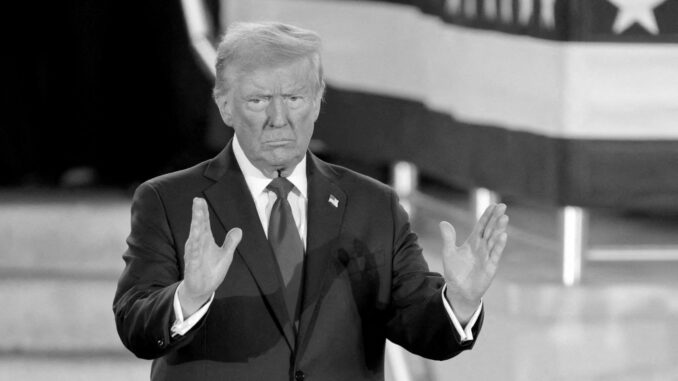
The illegal war started by President Donald Trump in Iran a month ago, on the edge of the international border and without the support of the United Nations, has hit the world economy. It is also an information war against conflicting ideas launched by those responsible for being able to bring about an end to the conflict. Uncertainty brings instability enormous volatility in the stock, gas and oil markets.
The North American economy is also recovering. Not only does one suffer from rising prices and dubious growth, but in most cases the cost of financing the massive public debt of $39 billion (over 100% of GDP). The yield on the 30-year EEUU bond rose 5% over the past month.
With every tenth of an increase in revenue, the cost of debt refinancing increases to $39,000 million. The war is costing the US, including a huge military burden, cases of $300,000 million more to finance the public debt.
This situation may aggravate you if the war is prolonged. Because of the North American president’s interest in ending this conflict, he will go to the polls earlier to evaluate his mid-term mandate next November.
Their voters believed they wanted to “Make America Great Again” (MAGA), and they are doing it right now This will also refresh the gas tank and shopping cart; and you can quickly see it in mortgages, even before the foreseeable future types of interest rates for central banks to control the inflationary wave.
We now decide to strengthen our energy reserves to avoid future crises, simply as a precautionary measure
This explains the extension until April 6 of the latest messages President Trump sent to Iran to respond to the Hormuz threat. All indications are that diplomacy has begunand the markets will fill it to discount.
The question is how long it will take to negotiate an end to the conflict on both sides, as Iran is showing more resilience than the North American president imagined. At the moment it is playing against the world economy.
Without the embargo, even if the war ends soon, oil and gas prices will not quickly fall to lower levels. Firstly, because companies have to accumulate reserves, currently minimal.
Given the magnitude of the shock, a change in behavior is expected in business and consumer countries: now we choose to Strengthen your energy reserves to avoid future crises, simply as a precaution.
Second, repairing the energy infrastructure of the Persian Gulf will cost at least 21,500 million euros. The Qatar gas plant and Iran’s South Pars gas plant – the mayor of the world – have been damaged and will take years to return to normal.
High oil and gas prices and their volatility make renewable energy more competitive
Before this energy crisis, the Donald Trump administration asked oil companies to increase production to stabilize the market. But increasing oil and gas production is not something that can be done immediately. Requiring millionaire inversions, long-term planning and stability, simply what is currently wrong.
This lower oil and gas production over the years, combined with strong global demand, will continue to raise energy prices even if the conflict ends quickly and traffic on the Ormuz side returns to normal.
Paradoxically, this context structural uncertainty obligates countries to seek to diversify their energy sources and open up new opportunities for renewable energy sources by accelerating the energy transition. High oil and gas prices and their volatility make renewable energy more competitive.
Spain has been moving away from clean energy in recent years – represent 59.7% of the energy mix – and solve this energy crisis in the best position as our European partners. The average price of electricity in what we are experiencing this year is consolidating at around €55/MWh in Spain, compared to an average of €100/MWh in Germany, France and Italy, due to the interest in electrifying our economy.
The impact of this war, even if it is ready, will translate into less global growth. Because the energy burden affects the entire economy, from transport to industry, through the increase in fertilizers – before the urea burden – and subsequently also food. We’re moving on an inflationary spiral which will also tend to have financial effects due to the increase in types of interest.
The OECD updated its forecasts at the end of December, including the impact of the war on the economy and prices. War-induced energy dependence is slowing European growth to a meager 0.8% against an expected 1.2%, and inflation will escalate into tenths.
On the other hand, the ECB believes that new deprivations pose a threat to stability and that higher energy prices will be reflected in food prices. Under the baseline scenario, inflation is expected to reach 3.1% in 2026, during the second quarter; If the conflict drags on and oil is at USD 145/barrel and natural gas at EUR 106/MWh, inflation will vary from 4.4% this year to 4.8% next year.
Here, the situation is worse: the Bank of Spain estimates an average inflation of 3% this year, but Please note that if there is a conflict, you may reach 6%.
Europe is finally preparing for a war economy. Although the issue of hostilities within the United States – Israel and Iran, the economy and world trade will not return to pre-conflict conditions.
On the one hand, the actual control of traffic in the Ormuz section of the Iran section was apparently questioned, including the aim of imposing a yuan tax payment on gasoline drivers that authorize them to use it. This ensures that a complete blockade of the port is not necessary if ships are occasionally attacked in an area where the security coast makes it difficult for ships with western security to navigate.
On the other hand, due to the rise in gas and oil prices in Europe, it is even more necessary to strengthen the strategic autonomy, energy security and defense of the EU. With a strong “Estate” paper to guarantee these goals.
Leave a Reply