
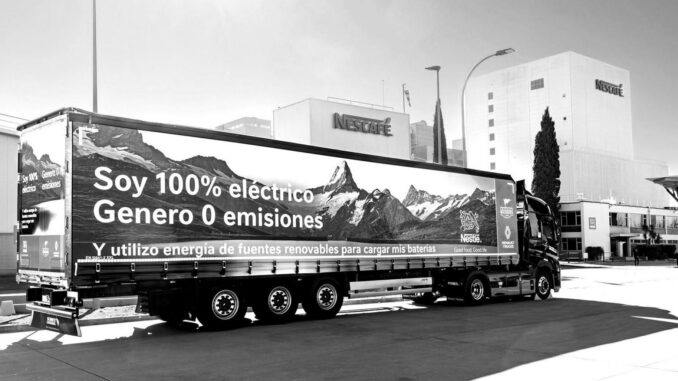
We have been discussed for a long time electrification of heavy transport how a technological extravaganza was born, a kind of futuristic whimsy reserved for holidays, corporate presentations and promotional videos.
But no: the truly extravagant thing at these high altitudes is to continue to defend that a country like Spain continues to depend on diesel trucks to transport the vast majority of its goods over relatively short distances, based on extinguishing imported fuel, emitting pollutants and accepting cost fluctuations beyond our control.
Rational, efficient and strategically intelligent This is exactly the opposite: electrify internal road transport and reinforce it with a railcar where it can be heard.
The interesting thing is that this conversation is not supported by abstract promises, but above real experience of use. Drivers who tested heavy electric trucks found very few epic questions and therefore very revealing: better visibility, fewer blind spots, less physical fatigue from not having to travel with traditional transmissions, less gas for maintenance, better behavior on slopes and an easier and safer driving experience.
It’s clear that they’re not speaking as technology evangelists, but as professionals who recognize top-of-the-line hardware when they use it. And that’s probably the best signal ever The change does not concern the terrain of ideology, down to the operational level.
The International Energy Agency takes a while to read that the total cost of ownership of electric trucks is improving on average, increasing their use
Moreover, the economic argument ends up being insultingly obvious. The International Energy Agency is taking its time to look into it total cost of ownership of electric trucks improves the drug, which increases its use, thanks to its higher energy efficiency and lower costs of operation and maintenance.
In its 2025 edition, the organization noted that large electric trucks are around 55% more energy efficient than their diesel equivalents and could reach the same total cost of ownership for long-distance operations in Europe by 2030, with unexpected effects.
In other words: yes, buying a second one is more expensive, but using it can be much better. Yes, in a sector with extreme margins, this is not an anecdote: it’s a revolution.
Spain also has some characteristics that make this transition geographically evident as well. We are not talking about a country-continent with thousands of kilometers of free logistics places between production hubs.
We are talking about a territory where a large part of inland transport is organized in equipment suitable for the true autonomy of many electric trucks, and where its European regulation obliges you to introduce periodic breaks that work much better. the logic of charging, which many would like to admit.
The problem is not that the truck has to stop, but that it always has to stop
European legislation sets strict limits on driving time and deceleration, and the IEA says that a mandatory 45-minute break in the EU can add up to 150 kilometers of autonomy with 350 kW chargers and up to 400 kilometers with a de nivel megavatio charger.
that’s it the problem is not that the truck has to stop, but that it always has to stop. The difference is that now this shield can also be used for charging.
The real debate is therefore not technological, but political and infrastructural. Spain needs not to wait for thousands, but to deploy reasonable heavy-duty cargo in large logistics facilities and supplement it with some well-chosen secondary hubs.
Nothing particularly esoteric. European regulation of alternative infrastructures sets binding targets To describe high-performance heavy vehicle charging in the red TEN-T and in urban nodes, the EAFO European Observatory recorded hundreds of heavy vehicle charging points in Europe in 2025, with the red still getting denser.
Let me put it another way: the direction is marked. It is wrong to act like Spain as an anthropological exception unable to do what the rest of the continent is trying to normalize.
As of now, the strategic opportunity is huge. A system of transporting goods on electric trucks and, where the truth is solved on the structural problem of maintenance and reliability, on electric goods trains, not only reduces emissions.
Reduce addiction. Reduce exposure to oil shocks. Reduce noise, urban pollution and utility costs.
And above all, it shifts the center of gravity of the system: instead of depending on imported and geopolitically fragile fossil fuels, we depend on electricity, which can be even more renewable in a country like Spain. Red Electrica confirmed that renewables accounted for 56.8% of national electricity generation in 2024, an all-time high. To think of this system with more storage, more flexibility and intelligence than red is not a green fantasy: It is basic industrial planning.
Naturally, you will have to repeat the usual catechism: that batteries are heavy, that batteries are heavy, that the transition is this money, that they are not needed for everything. But everything is certain completely irrelevant as a basic goal.
No technology can be changed overnight and does not cover 100% of cases from day one. It is not a sensible idea to assume that an electric truck will be used for absolutely any journey imaginable, as it will serve you in a very short time.
And the answer is clear, given the evolution of autonomy, infrastructure and regulation: for many. What is enough to buy diesel without a solid strategy is to act less prudent than absurd nonsense and inertia.
Question, below, we will not electrify internal transport. Application ex So let’s pretend we don’t know this is the logical conclusion.
Spain has sun, wind, renewable capacities, reasonable distances, a natural integration with Europe that increases charging density, and a clear need to gain energy autonomy and logistical competitiveness. Sticking with diesel is not realistic. It’s simply a bad decision.
***Enrique Dans is Professor of Innovation at IE University.
Leave a Reply