
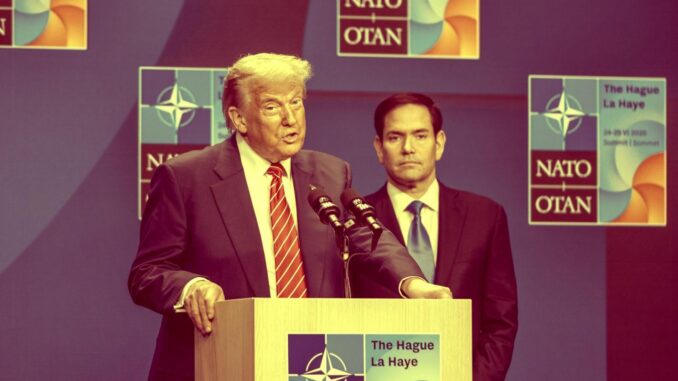
As soon as Donald Trump arrives in Europe, the Old Continent reacts like a disciplined debtor to being forced to record his signature on the security police. Promise more gasto, promise more purchases, promise more strategic obedience.
The issue is not so much a break with the United States or an embrace of adolescent anti-Americanism; As many years of Western architecture as possible, until we began to think seriously about what it would mean for Europe to stop living in OTAN as a perpetual tenant and force yourself to act like a force.
The question doesn’t have to be diplomatic. It is probably industrial, fiscal, technological and ultimately civilized. Europe does not have to give up multilateralism. One must abandon one’s minority of children.
The problem is that leaving NATO, or even emptying its contents just to turn it into a formal alliance, but not an existential one, will cost an enormous amount. And that’s why it’s worth writing about.
Because the debate is real, Brussels must not declare a collective coalition, which is politically improbable and militarily imprudent, until Europe builds the material conditions to ensure that today this sad dejara de ser is unthinkable. Hoy no las tener.
In Europe, it has an industrial defense center whose aggregate size corresponds to a large production force
European Defense continues to scan its current delivery, intelligence, strategic transport, refueling, missile, satellite, anti-aircraft defense and nuclear defense capabilities. Meanwhile, OTAN’s ability to raise its ambitions is 5% of GDP by 2035, with 3.5% for “core” defense and another 1.5% for security-related gases. Europe does not have to pay more if not better and less dependent on the other side of the Atlantic.
Now, if Europe decides to truly challenge this permanent ultimatum, the first conclusion will be unpleasant. Strategic autonomy cannot be built with leaders, but with leadership rolescommon standards, gas efficiency, patient funding and industry concentration.
With a nominal PIB that exceeds 22 billion euros; including factoring into the UK, each additional point of gas in defense equates to tens of thousands of miles per year. On a European scale, it will be around 3% of the expected GDP an effort averaging billions of euros per year.
It is a well-designed industrial policy that will have multiplier effects far beyond those of a simple arms industry: electronics, advanced materials, software, cyber security, energy, space, secure communications, automation and precision manufacturing.
Would you like to see this remodel happen? In pure defense there are clear names above the table. Airbus Defense and Space, Leonardo, Thales, Rheinmetall, Saab, Hensoldt; Europe has an industrial defense center that equates in large quantities to a large manufacturing force.
Europe produces a small amount in duplicate, buy a small amount and it’s too late to decide
No candle part. It has companies capable of generating around 150,000 million euros per year with a total market value of more than 350,000 million, but dispersed and with a common strategy on a continental scale.
Ahí están cimientos European backbone in military aviation, electronic warfare, missiles, radars, opttronics, vehicles, municipality, check-in and management. The problem isn’t a lack of champions.
The problem is fragmentation. Europe duplicates spare parts, buys spare parts in small quantities and takes a long time to make decisions. It has shops, but not always the political economy of defense.
However, the interesting article fills in exactly where the usual list of military suppliers ends. Because the European Defense Union does not levy only these companies. Levant environment ASML, Infineon and STMicroelectronics, porque sin lithography, power chips, sensors and control electronics no drones, radars, satellites, missiles guided by rugged data centers.
The 21st century army is not all maple, dust and armor. These are semiconductors, photonics, embedded software and high-end manufacturing capacity. Europe assumes it has “technological sovereignty” but is trying to defend itself without the protection of Washington, which is trying to secure its industrial base because it was a strategic infrastructure equivalent to a fleet or a power grid.
And now the next derivation seems to be much less controversial. A serious European defense would also require the reindustrialization of energy. There is no military autonomy without energy security, no continuous production of armaments without robust systems, turbines, transformers, industrial automation and massive electrification capacity.
Siemens Energy, Schneider Electric or ABBYou can compete without your peers from Korea, Japan or other countries. It does not belong in the Turbines and Redes sector of the military supplier, but is an essential part of any resilience architecture.
Likewise, groups like Indra, for its position in radars, surveillance, air traffic, control and systems, or Eutelsat and SES, for its paper in secure and multi-orbital connectivity, will tend to live naturally in a defense union that embodies security as a package of capabilities, not as a weapons cache.
The defense of borders, waters, airspace, submarine cables and digital nodes seems less likely to fall within the geography of 1985 and more within the critical infrastructure of advanced capitalism.
The European space industry will itself require a conceptual revolution. ESA has a budget of approximately one million euros until 2025. The estimated European preliminary estimate will reach 11,400 million in 2024, of which three cases will be managed by the company’s own agency.
By comparison, NASA projected the military in 2025 with total funding of $35,600 million, and above all with the structural tradition of integration between industry, science, security and strategic power that Europe has never failed to recognize in its own sphere.
Its own ESA admitted that more than 85% of Europe’s space requirements were civilian, a very different composition to the other major space actors. In another way, Europe has a powerful spatial agency but does not yet have a spatial doctrine of power.
The most provocative part of the argument is this: leaving NATO could be economically less costly than Catalyst. Not because the rupture would be overshadowed, but because it would force Europe to do what it never wanted to do by vision.
Consolidate consortia, combine procurement, eliminate two joint defense forces, redirect production capital, rebuild production capabilities, turn ESA into an operational strategic management platform, integrate the UK and Norway into the industrial and technology pillar, and design a defense policy that does not confuse autonomy with autonomy and strategy.
Weaknesses are evident: national duplicity, political resistance to the surrender of sovereignty, fiscal heterogeneity, France’s nuclear dependency, lack of integrated management and declines in infrastructure financing. However, none of these weaknesses are metaphysical. These are problems of decision-making, coordination and scope. Europa knows how to make all the cases you need; what you don’t know or don’t want to do is organize yourself to do it as best you can.
The tragedy, of course, is that none of this will happen. Not in this Europe fragmented, divided, bureaucratic, fiscally enveloping and politically exhausting, where every leader confuses continental interest with the lousy arithmetic of his next election, but no one can protect his country’s interests, not even those of his own party’s survival.
The old project of a powerful Europe, capable of marketing, innovation, deterrence and reasoning alike, has degraded itself until it appears as a conglomerate of catastrophes that governs norms with perfection in history.
And so each of Trump’s complaints will continue to produce the same servile reflex, not that Europe cares about money, industry or talent until it has time to believe that oppression was also an economic verb.
Leave a Reply