
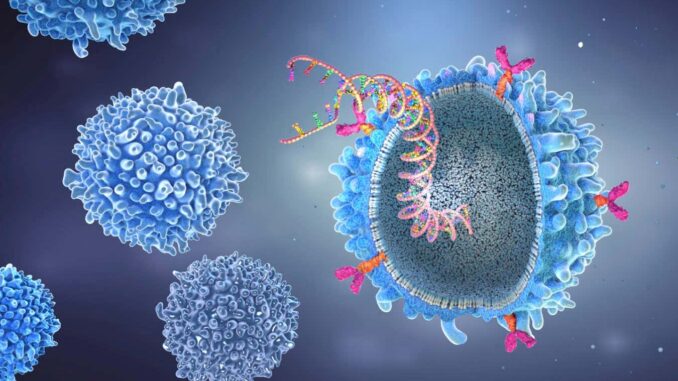
Illustration of a CAR T-cell with an implanted gene stem resulting from the genetic modification process needed to fight rogue cells in the body
CHRISTOPH BURGSTEDT/SCIENTIFIC PHOTO LIBRARY
A woman who had three different autoimmune conditions required no treatment for almost a year after her immune cells were genetically modified and used to kill harmful cells attacking her body. “She was terminally ill and bedridden by the time we met her and we treated her, and she was out of bed seven days later,” he says. Fabian Müller at the Erlangen University Hospital in Germany. Within months she appeared to have fully recovered. “I saw her just yesterday. She is absolutely fine,” says Müller, 11 months after treatment.
The woman is one of a growing number of people with autoimmune diseases who have been successfully treated in this way, and the first to undergo treatment for three different diseases at the same time. “What’s really crazy is that you have three autoimmune diseases and you happen to be able to manage all three with one treatment,” says Müller.
In response to, say, a viral infection, our bodies generate lots of new immune cells with random mutations. These mutant cells are then put through a screening process to select those that make antibodies that bind to the virus and to eliminate any that make antibodies that attack our own bodies. Sometimes, however, self-targeting immune cells slip through this selection process, and once they do, they can persist throughout life.
In the case of the woman, this happened when she became pregnant more than ten years ago. Her body began producing antibodies that attached to her red blood cells that carry oxygen from the lungs to the rest of the body, resulting in their destruction. This potentially fatal condition is called autoimmune hemolytic anemia.
Her immune system also began producing antibodies that targeted her platelets, cell fragments that help blood clot — a condition called immune thrombocytopenia. Third, she started making antibodies against certain proteins that help prevent blood clots, meaning she was also at greater risk of the opposite problem: the formation of dangerous blood clots, known as antiphospholipid syndrome.
The woman was treated with a number of immune-suppressing drugs, but none worked well. She needed regular blood transfusions to survive, along with blood thinners to prevent clots.
She was eventually referred to Müller, whose team was the first to treat autoimmune disease with CAR T-cells in 2022. Previously, CAR T-cells were only used to treat cancer.
CAR T-cells are T-cells – immune cells that usually kill infected or cancerous cells – that are taken from a person undergoing treatment. They are genetically engineered in the lab to make them attack a specific target and then infused back into that person.
To treat this woman, Müller’s team produced CAR T-cells that target antibody-producing immune cells. When the engineered cells were infused into her, they killed her antibody-producing cells.
This did not completely wipe out her immune system – she still had unmodified T-cells as well as her oldest cells producing antibodies against childhood infections and vaccinations. “They sit in the bones, they are not affected,” says Müller.
In fact, her immune system recognized the CAR T-cells as foreign and killed them all within months, allowing the creation of new antibody-producing cells. This means her immune system is back to normal, but without a bunch of antibody-making cells, including the ones that caused her illness.
The CAR-T approach has shown promise for a wide range of autoimmune conditions, including lupus, multiple sclerosis, colitis and severe asthma. When CAR T-cells are used to treat cancer, they often cause serious side effects, but this is not seen in autoimmune conditions. These side effects may be the result of killing huge numbers of cancer cells, says Müller. In autoimmune conditions, far fewer cells need to be killed.
The woman has some minor lingering effects, but the team thinks they are the result of her previous drug therapies, rather than the CAR-T treatment. “For a therapy that is very effective, in this particular case, it has very few side effects and then leads to resolution of the underlying condition,” he says. Reuben Benjamin at King’s College London. “This is a fantastic result.
So far, most people treated for autoimmune conditions with CAR T-cell therapy have remained disease-free, Benjamin says, but there have been some cases where the self-targeting cells have reappeared and further CAR-T treatment has been necessary.
“Longer follow-up is needed before anyone can talk with certainty about treatment,” he says Jun Shi at the Chinese Academy of Medical Sciences in Tianjin, whose team used CAR T-cell therapy in 15 people with autoimmune hemolytic anemia as part of pending trial.
CAR-T treatments are extremely expensive due to their personalized nature – in cancer, costs range from $200,000 to $600,000 — but Müller points out that the ongoing costs of treating autoimmune conditions can be even higher, and the treatment is so effective that people can often return to work. “It costs a lot initially, but you save a lot of money in the long run,” he says.
topics:
Leave a Reply