
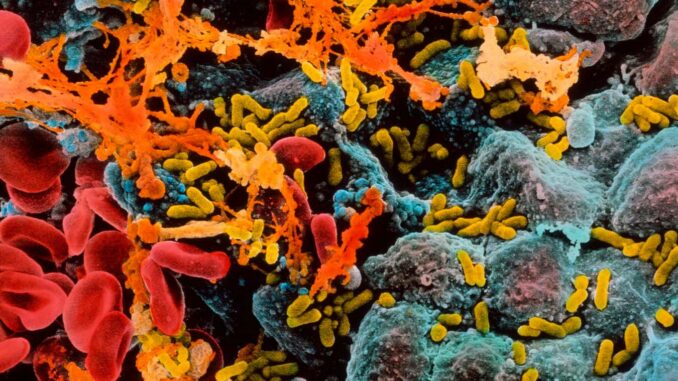
Scanning electron microscope image E. coli (yellow) infecting cells in a human bladder (blue), causing them to secrete thick mucus (orange)
PROFESSOR PM MOTTA ET AL/SCIENCE PHOTO LIBRARY
Severe cystitis, pneumonia or tooth decay could increase the risk of dementia. A study of hundreds of thousands of people across Finland found that people treated in hospital for these infections were significantly more likely to develop dementia – including the early-onset form – within the next six years.
We increasingly think that dementia, including Alzheimer’s disease, can be prevented or delayed with brain training games, persistent lifestyle changes and even saunas. The latest research now adds to the growing body of evidence supporting avoiding infections to further reduce the likelihood of developing the condition. “It suggests that the risk of dementia may be partly modifiable,” he says Kuan-Ching Wu at Emory University in Atlanta, Georgia, who was not involved in the study.
in 2021 Pyry Sipilä at the University of Helsinki and his colleagues noticed this people who were hospitalized with serious infections were more likely to develop dementia. However, it was not clear whether this was because they had other conditions, such as diabetes, which increase the risk of both dementia and susceptibility to infection.
To unravel this, they now analyzed the medical records of 62,555 people aged 65 or older who were not diagnosed with dementia in 2016, but who received a diagnosis between 2017 and 2020. These people were compared with another 312,772 individuals without dementia, whom the team matched by age, gender and level of education. For all participants, the researchers tracked any diagnoses and hospitalizations that occurred during the previous two decades.
The team identified 29 conditions that were associated with at least a 20 percent higher risk of developing dementia an average of five to six years later. Most were non-infectious, such as conditions that affect the heart or brain. But two were infections: cystitis — a urinary tract infection (UTI) that is usually caused by bacteria — and a bacterial infection with no specific site noted in the records. Further analysis revealed that most of the increased risk of dementia was related to these infections, not 27 other conditions.
Although inflammation is an important immune response to infection, it is also a critical component of some types of dementia, such as Alzheimer’s disease. Infection-related inflammation could trigger a circulatory system disruption that affects the brain, causing microscopic bleeding or infiltration of toxins across the blood-brain barrier, Sipilä says. There is also growing evidence that vaccines against infections such as shingles and influenza reduce the risk of dementia.
In another part of the study, the researchers focused on early-onset dementia, which occurs before the age of 65. They found that Parkinson’s disease and head trauma appeared to increase the risk the most, but numerous infections were also associated with gastroenteritis, infectious or unspecified colitis (inflammation of the large intestine), pneumonia, tooth decay and bacterial infections of unspecified sites.
It is unclear why some infections are associated with early-onset dementia but not regular-onset dementia, and vice versa, but the researchers note in their paper that the causes and genetic susceptibility associated with these forms of the condition differ.
Despite these strong associations, we don’t know whether these infections actually cause dementia, or whether the team just observed correlations despite trying to adjust for them, says Sipilä. “Ideally, intervention studies should investigate whether better infection prevention helps reduce the incidence of dementia or delay the onset of the disease,” he says.
Gill Livingston at University College London says she wouldn’t be surprised if such research confirmed a cause-and-effect relationship. “This high-quality study, consistent with other evidence, timeline and biological plausibility, makes it more likely,” he says.
This could inspire better prevention, management and monitoring of serious infections, Wu says. For cystitis, for example, prevention may include ensuring adequate hydration and good incontinence care. “On the management side, prompt treatment is especially important because UTIs in older adults often present atypically—such as confusion or delirium rather than classic symptoms—which means they may be missed or treated too late,” he says. “Overall, this research is both alarming and motivating.”
topics:
Leave a Reply