
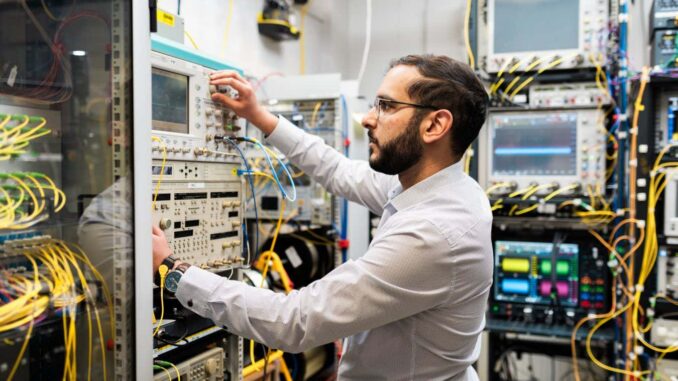
Team member Ronit Sohanpal works to set up high-speed data transfer
UCL
A new speed record has been set for the transmission of data over an existing, commercially installed fiber optic cable, with 450 terabits per second – or 450,000,000,000,000 bits per second – transmitted over a pair of cables under busy London streets.
Polina Bayvelová at University College London and colleagues achieved the record using existing fiber optic cables running from their lab in Bloomsbury to a data center in Canary Wharf and back. This data transfer rate would be enough to stream approximately 50 million movies simultaneously.
Bayvel says the record achieved data rates around ten times faster than current commercial networks, meaning that if it were widely deployed, we could see an increase in internet bandwidth equivalent to adding nine new cables to every existing one, without going through the expense or inconvenience of installing one meter more cable.
Such a jump in data transfer speeds might be so big that human internet users can’t take advantage of it, but that the AI boom could certainly take advantage of. “There’s only so much data anyone can process — you can only watch so many movies,” he says. “But the AI infrastructure generates a lot of data and spits that data out into the network.”
The record was achieved thanks to specially developed hardware that made it possible to send data in a wide range of frequencies – from 1264 nanometers to 1617.8 nanometers – far beyond what is used in commercial networks today. These different frequencies required different new approaches to correct for the different magnitudes and types of distortion, as the laser pulses hit different indices of refraction inside fiber optic cables at different intensities.
Higher speeds have been achieved before in highly regulated experiments, but this work essentially used existing cables that were heavily used, have dirty connectors, sit under a busy city full of traffic and noise, and represent a real-world test showing that they could be introduced into existing infrastructure. The researchers say commercial rollout could take place within five years.
Kerrianne Harrington at the University of Bath, says there are two streams of research in fiber optics: squeezing more bandwidth out of cables already deployed at high cost, and developing new types of cables to remove some of the technology’s bottlenecks.
“The interesting thing about this work is that it uses what’s already in the ground, which is an expensive thing to change,” says Harrington. “I think it’s a very practical approach to the problem. I would argue that the work that’s presented in this paper has a more immediate benefit to increasing capacity than new fibers.”
topics:
Leave a Reply