
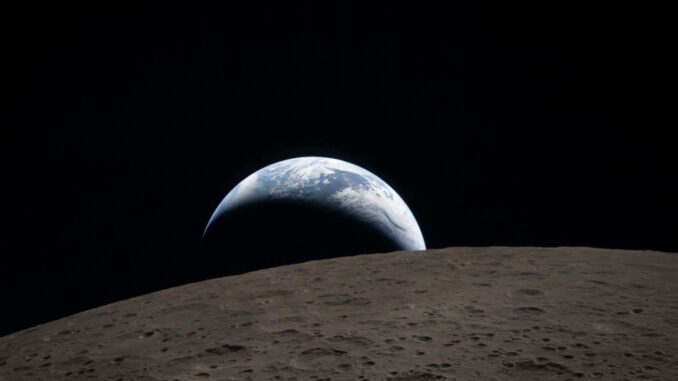
On April 6, astronauts on NASA’s Artemis II mission looped around the far side of the Moon. They traveled more than 406,700 kilometers from Earth, further than anyone had traveled before.
The four crew members — Reid Wiseman, Christina Koch, Victor Glover and Jeremy Hansen — took turns at the windows of the Orion capsule, looking at Earth and the Moon (above). The reflection of sunlight from the Earth’s surface, called Earthshine, was so bright that they covered one of the windows with a spare shirt.
As they passed behind the moon, the astronauts got a glimpse of areas never before seen by human eyes, such as an entire crater called the Orientale basin (below). The dark spot in the center of the crater is dried lava from an eruption billions of years ago. The astronauts proposed new names for two smaller craters near Orientale: Integrity, after their spacecraft, and Carroll, after Wiseman’s late wife.

During the mission, the phases of both the Earth and the Moon changed rapidly from the spacecraft’s point of view. “The moon is jagged and the earth is a crescent,” Hansen said at one point. As Orion began to circle the far side of the Moon, the crescent of the Earth fell behind the Moon (below).

Glover expressed a particular fascination with the lunar terminator, the line between day and night. In this line, sunlight hits the ground at a sharp angle that casts long shadows, highlighting the terrain and revealing details that would not be visible in full lighting (below). “There’s just so much magic in Terminator – islands of light, valleys that look like black holes [where] if you stepped into some, you would fall right into the center of the moon. It’s just so visually captivating,” he said.

While on the other side, the astronauts could not communicate with mission control on Earth, but continued to take pictures and dictate notes into voice recorders. At one point, they witnessed a unique solar eclipse that lasted nearly an hour (below). The Sun was completely hidden behind the Moon, while the side of the Moon facing Earth remained illuminated by the Earth’s light.

Now that their flyby has been successful, the astronauts are on their way back to Earth. It is expected to arrive on April 10 when Orion splashes off the coast of California.
topics:
Leave a Reply