
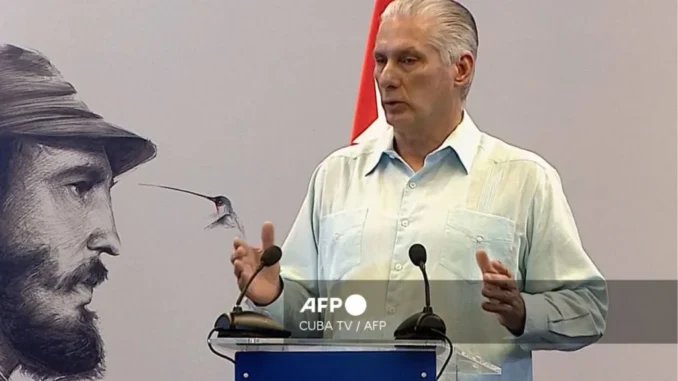
The Cuban president, Miguel Diaz-Canelconfirmed this Friday that his country maintains talks with the United Stateswhich applies a maximum pressure policy against the communist island.
Donald Trump does not hide his desire for a regime change in Cubalocated just 150 kilometers from the United States. According to Washington, it represents a “exceptional threat“, mainly due to its close relations with Russia, China and Iran, allies of Havana.
The US president urged Cuba to “reach an agreement” or face the consequences. The island faces an energy crisis that has almost completely paralyzed its economy after Washington cut off oil shipments from Venezuela, its main supplier, and threatened sanctions on other countries that sell it fuel.
“Cuban officials have recently held conversations with representatives of the United States government,” Díaz-Canel said in a meeting with members of the highest levels of the ruling Communist Party (PCC, sole) and members of the executive committee of the Council of Ministers, in images broadcast by Cuban television.
These conversations “have been aimed at seeking solutions through dialogue to the bilateral differences that we have between the two nations.”“Díaz-Canel said.

According to television images, among the leaders, in the front row, was Raúl Guillermo Rodríguez Castrograndson of former president Raúl Castro (2006-2018) and who has been mentioned by the US media as the interlocutor of the head of US diplomacy, Marco Rubio, in the context of secret conversations.
Díaz-Canel’s statements confirm what was stated by Trump, who already indicated in mid-January that his government was holding talks with senior leaders of the island.
The Cuban president stressed that talks with the United States are facilitated by “international factors”which he did not specify,
On Thursday night, his government announced the upcoming release of 51 prisoners under the auspices of the Vatican, the historic mediator between Cuba and the United States.
Avoid confrontation
The conversations with The United States seeks “first to identify which bilateral problems need a solution based on their severity.”“and” look for solutions,” said Díaz-Canel.
He stressed that it is a “very sensitive process“which “demands enormous and arduous efforts to find spaces of understanding that allow us to move forward and move away from confrontation.”
The Catholic Church has acted for decades as a mediator and channel of dialogue between Cuba and the United States. and played a key role in the thaw of diplomatic relations between the two countries in 2015, during Barack Obama’s second term (2013-2017).
On February 28, during a diplomatic tour of Europe, the Cuban Minister of Foreign Affairs, Bruno Rodríguez, was received in audience by Pope Leo XIV.
a week before, the secretary of the Holy See for Relations with States, Paul Richard Gallagher, had met with two American diplomats: the chargé d’affaires in Havana, Mike Hammer, and the ambassador to the Vatican, Brian Burch.
According to the NGO 11J, which registers arrests in Cuba Since the demonstrations of July 11, 2021, when thousands of people took to the streets with shouts of “freedom” and “down with the dictatorship,” there are at least 760 prisoners in the country for political reasons, including 358 participants in those historic anti-government protests.
At the end of February, Trump said he was studying a “friendly takeover” of Cuba. “They don’t have money, they don’t have anything right now, but they are talking to us and maybe we will see a friendly takeover of Cuba,” he declared.
Leave a Reply