
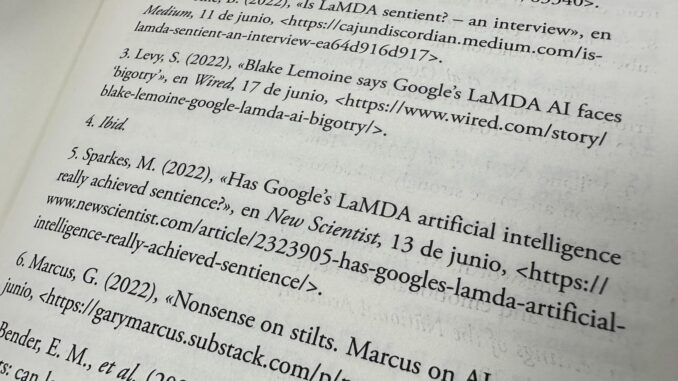
Let me once again devote this column to the “technical” question of character. Verán: in my work as a table editor, I respond to the offer of the bibliography, the offer of many prolies. They usually bring me a zorro and it takes me a lot of time to satisfy them.
Authors are very few because they are wise or experts who are good at bibliographic data. The offer combines the various available models and they are rarely consistent with the period of regular use and standardization criteria. The most common majority is that one copies the otherso it is not unusual to detect the worst mistakes – sometimes including wrong mistakes – in the bibliographies of many books dealing with the same subject.
Bibliography is a field for general asphalt in which every master (including me) has a booklet for a short time. I don’t want to go into this garden now, it may be necessary to go through all the pages of this magazine to at least untangle the letter casuistry that leads to the assumption. But yes, I want to fix it the very absurd way I often cite bibliographic sources available in red in business books.
For all parts one with notes or bibliographies, to outline a good example, the author provides data such as: https://www.theatlantic.com/ideas/archive/2023/12/cell-phones-student-test-scores-dropping/676889/. Do these demons need a commitment on paper, such a hint? Can anyone imagine someone going to the trouble of transcribing that alphanumeric sequence into their text in order to search for it on Google or any other search engine looking for the resource in question?
In the note I copy this direction, taken from the beginning of a very recently published book, of a popular nature, the full information is as follows: “Derek Thompson, ‘It Sure Looks Like Phones Are Making Students Dumber,’ The Atlantic, December 19, 2023, consulted May 29, 2024.”
Ancient usages that highlight the resistance of editorial practices to taking on the implications of technology seem to lie
The author follows a widely spread reference system that seems to be consolidated in academia and which, after entering the if I am really being very strict, but for practical purposes it represents, at least in my judgment, a disproportion. It is different when instead of a printed book it is a digital support that allows you to click in an electronic direction and access it directly. But on paper… From time to time I laugh at the book notes or bibliography, pages and even more pages infested with these useless alphanumeric sequences that do nothing but honor and worry about these sections, which are so dry and bureaucratic, in any way they think or process.
Let’s look at an illustrated example. The author, as recommended by the most prominent manuals, indicates the time when the source in question was consulted. This fact testifies to the ephemeral nature of a significant number of these resources, which are updated or updated or moved from place over time. Detailing work by copying the entire lace sequence is thus much more free.
A much more operative indication is added to the conventional form “available in red” or similar text for the reader to read. As a general rule, copying the author’s name and the first paragraph of the title of your paper into a search engine will suffice to link to the source of the questions.
It seems a lie that, with so many decades of massive digitization, we retain ancient usages that emphasize editorial practices’ resistance to accepting the implications of the very different technologies of the printed book and electronic documents.
Leave a Reply