
The tariff reductions of the controversial free trade agreement between the European Union and Mercosur –which is based in the exchange of beef and Latin American agricultural products by cars and machinery of the European Union – will begin to be applied provisionally from May 1, as announced this Monday by the Commission of Ursula von der Leyen.
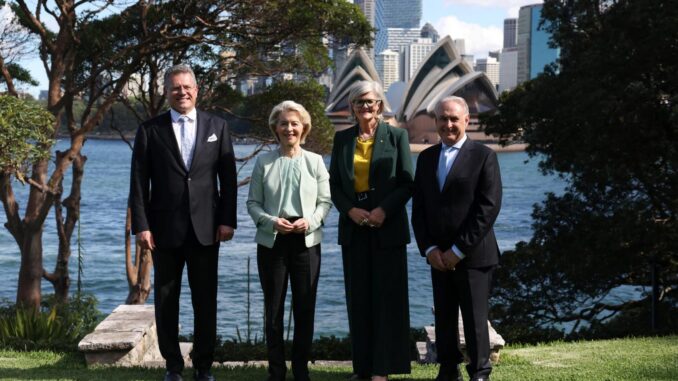
The president of the community Executive (who is in Sydney to sign a new trade pact with Australia this Tuesday) has decided accelerate entry into force of the agreement with the North American bloc, without waiting for ratification by the European Parliament, as a reaction to the tariff chaos unleashed by Donald Trump.
The European Parliament decided in January to refer the agreement with Mercosur to Court of Justice of the European Union (CJEU) to rule on its legality, which has left its ratification suspended for months.
Despite this, Brussels has chosen to immediately apply the tariff reductions, without waiting for the ruling, despite the frontal opposition of France and Poland and the European agricultural sector, which fears unfair competition from Latin American products.
Specifically, the Commission This Monday he sent a ‘note verbal’ to Paraguaydepositary of the Mercosur treaties, thus taking the last procedural step necessary to provisionally activate the tariff reductions.
The agreement will be applied provisionally from May 1 between the EU and all Mercosur countries that have completed their ratification procedures and have notified it before the end of March.
Argentina, Brazil and Uruguay have already done it. Paraguay has recently ratified the agreement and is expected to send its notification shortly, as reported by the Community Executive.
“The provisional application will allow eliminate tariffs on certain products from day onecreating a predictable framework for trade and investment”, as highlighted by the Commission.
“European companies, consumers and farmers will thus be able to immediately start benefiting from the agreement, while sensitive sectors of the EU economy will be fully protected by strong safeguards,” Brussels maintains.
Exporters will be able to obtain more information on how to benefit from this agreement through the Access2Markets platform. All information will soon be available online.
“Today we take an important step to demonstrate our credibility as a leading trading partner. The priority now is to translate this agreement between the EU and Mercosur into concrete results, providing European exporters with the platform they need to take advantage of new opportunities for trade, growth and employment,” said Trade Commissioner Maros Sefcovic.
“Provisional application will allow us to begin to fulfill that promise. I am confident that this agreement will realize its full potential, strengthening our economy and consolidating our position in global trade, while we complete all democratic procedures,” says Sefcovic.
The agreement with the Latin American bloc will form a market of 700 million inhabitants and will save European exporters 4 billion euros a year in tariffs, according to Brussels.
Specifically, Mercosur’s “prohibitive tariffs” on key industrial products such as automobiles (currently 35%), machinery (14-20%) and pharmaceuticals (up to 14%) are cut.
It is estimated that the agreement can increase annual EU exports to Mercosur by up to 39% (49 billion euros), supporting more than 440,000 jobs in Europe.
Although the pact has provoked strong rejection in the primary sector (with protests in numerous EU capitals), Brussels maintains that it will allow increase European agri-food exports to Mercosur by 50%thanks to the reduction of tariffs on key products such as wines and spirits (up to 35%), chocolate (20%) and olive oil (10%).
In addition, the pact protects 344 Community geographical indications against any imitation. For the most sensitive products (beef, chicken, rice and sugar), the EU has approved a monitoring and early warning mechanism to detect any sharp increase in imports, which would allow tariffs to be reintroduced.
Leave a Reply