
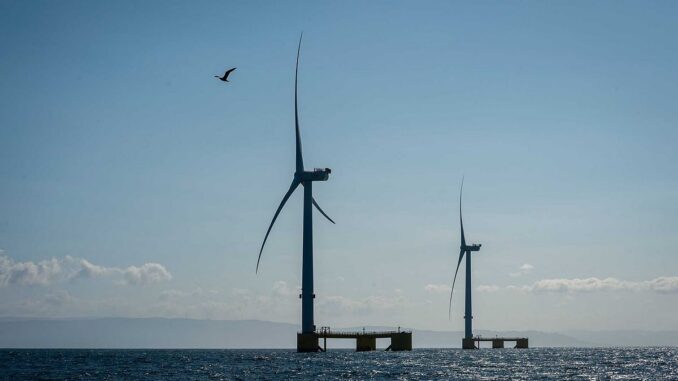
EDP increased electricity production by 4% in the first quarter, to 19 Terawatt-hours (TWh), driven by wind and solar generation, with renewable energies representing 91% of total production, the company reported this Friday, 17th.
“The increase in hydro and wind production, following successive storms since the end of January, contributed to a significant growth in renewable production and a 48% decrease in the average price of electricity in the Iberian Peninsula”, says EDP in a statement sent to the Securities Market Commission (CMVM), with forecast operational data for the first three months of the year.
According to details, the average price of electricity in Iberia went from 85.3 euros per Megawatt-hour (euros/MWh) in the first quarter of 2025 to 44.2 euros/MWh in the first quarter of 2026, “despite a temporarily low average price of 16.4 euros/MWh recorded in February, due to excessive precipitation”.
Until March, water production in the Iberian Peninsula reached 4.3 TWh, 0.9 TWh above expected, as a result of “strong water resources”, 52% above the historical average (+42% in the first quarter of 2025).
Wind and solar production increased by 4% year-on-year to 11.5 TWh (including solar distributed in Europe and Brazil), supported by a 6% increase in installed capacity in the last 12 months (with a greater contribution from North America, mainly in solar), and by better wind and solar resources in Europe, with renewable resources remaining close to the long-term average, supporting the increase in production volumes.
The company led by Miguel Stilwell de Andrade reports an increase in thermal production by 4% year-on-year, driven by gas production in Portugal (+38% in the first quarter of 2025), “reflecting greater demand for complete services and flexible energy, after a temporary interruption in the transmission/interconnection system in February and March caused by storms”.
“Consequently, the component of electrical system services and restrictions on the final price of electricity, supported by the sale of electricity, registered a significant increase in year-on-year terms”, he states.
In Iberia, electricity distributed by EDP increased by 1.1% from January to March, in the annual comparison.
In Portugal, demand for electricity in the company’s distribution network rose 2.5%, driven by greater penetration of electric vehicles in the market, an increase in the number of customers and higher average consumption per customer (a growth of 4.7% year-on-year in total consumption).
In Spain, electricity consumption in EDP’s distribution area decreased by 4%, due to a temporary interruption by a large industrial customer (compared with a 1% year-on-year growth in electricity demand in mainland Spain).
In Brazil, distributed electricity increased by 0.8% year-on-year, compared to annual growth of 7% in the first three months of 2025, “due to the normalization of temperatures and the greater penetration of distributed solar”, with the number of connected customers rising by 1.9% compared to the first quarter of 2025.
Data released by EDP also indicates that reservoir levels were at 94% at the end of March, a record in the last 10 years for this time of year (compared to 76% at the end of 2025 and 89% in March 2025).
“The high reservoir levels are expected to support the performance of the flexible generation business in the coming quarters”, says the company.
In the last 12 months, EDP says it has added 2.1 Gigawatts (GW) of total capacity (of which +2.0 GW at the level of EDP Renováveis (EDPR), with 1.9 GW of capacity under construction in March 2026, “reinforcing the capacity planned for 2026 and following years, with more than 90% of the 1.5 GW of capacity additions expected for 2026 already installed or under construction”.
Wind and solar installed capacity reached 21.2 GW (EBITDA + Equity) in the first quarter of 2026, an increase of 1.3 GW year on year (+6% in the first quarter of 2025).
Noting that the execution of the asset rotation plan for 2026 “should focus on the second half of the year”, the energy company says that, by the first quarter, it had completed the asset rotation transaction of a 150 MW wind portfolio in Greece.
Leave a Reply