
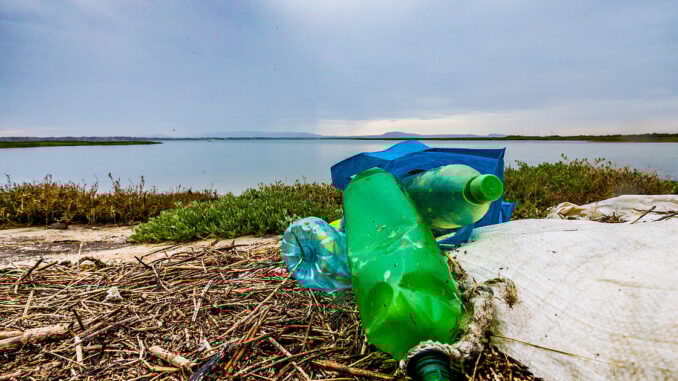
Plastics, microplastics and nanoplastics are increasingly present in the oceans. The first are the ones we see: cups, bottles, bags, which often cling to marine animals or end up in the sand on beaches. The latter, only visible with microscope lenses, come off items of clothing, packaging and other everyday objects. In common, whether big or small, a problem for which a group of scientists gathered in Portugal is looking for a solution: 80% of all plastic that ends up in the sea is transported by rivers.
The person presenting this data is the teacher Hilda de Pabloprofessor at the Faculty of Engineering at Universidade Lusófona and specialist in oceanography, who leads one of the working groups at the European project Free LitterAT. “The largest contribution of plastic to the ocean comes from land, from rivers. For us, it is very important to know what it is, how it gets in and how much it gets in. Although we are more focused on the ocean and coastal areas, the agreements now also really want to know what the role of rivers is in this whole issue of ocean contamination.“, explains the teacher to DN.
The agreements cited by the professor are the four Regional Maritime Conventions (CRMs), which cover the Northeast Atlantic (OSPAR), the Mediterranean (UNEP-MAP), the Baltic Sea (HELCOM) and the Black Sea (Bucharest Convention). Representatives of the four, as well as researchers from Portugal and 29 other countries, in a total of 60 international organizations, are participating in an event that begins this Wednesday, March 25, in Cascais, to discuss possible ways of monitoring the supply of plastic that rivers carry into the ocean.
One of the main difficulties is the lack of numbers relating to this flow. And the longer the course of a river, the greater the chance of more plastic being transported to the sea. In the case of Portugal, “the rivers are significant, very long and cross-border”, highlights Hilda de Pablo. “Their peculiarity is that they all flow into the Atlantic Ocean and, as in most countries, the population is much more centered in coastal areas. Their contribution [de plástico] It is also significant and all this type of control must be standardized”, he adds.
The event is part of the coordination meeting of the Free LitterAT project, which involves 23 organizations from Portugal, Spain, France and Ireland, and aims to protect marine biodiversity, promoting strategies to prevent and reduce litter in the oceans.
Leave a Reply