
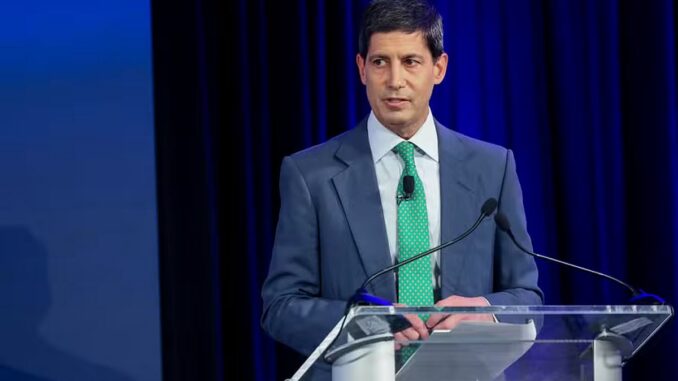
The US Federal Reserve decides this Wednesday, 18th, on monetary policy, in the first meeting after the conflict with Iran, which has caused energy prices to rise, but interest rates should remain stable, according to analysts.
Michele Morganti, senior equity strategist at Generali AM, pointed out, in an analysis, that “in the base scenario, central banks should ignore the temporary spike in inflation”.
The Fed meeting, in the same week as the European Central Bank (ECB), takes place at a time when tensions in the Middle East, including the closure of the Strait of Hormuz, through which around 20% of global oil production and almost 20% of liquefied natural gas pass, have brought greater volatility in prices, especially energy.
The Fed “will probably make an interest rate cut later this year (sooner than the market currently projects), while the ECB is expected to keep rates unchanged (compared to the +47 basis points projected until the end of the year)”, highlighted the analyst, and “only in a scenario of prolonged escalation” could it be expected that “the ECB would raise rates by up to 50 bp and the Fed by 25 bp by the end of 2026”.
The US central bank will reveal the decision today at a press conference, accompanied by new economic forecasts.
At the January meeting, the Federal Open Market Committee (FOMC) “maintained the rate in the range of 3.50% to 3.75%, emphasizing a data-dependent approach in the face of resilient growth and persistent pressures on underlying inflation”, recalled Xtb, in an anticipation note.
“No change is expected”, indicate Xtb analysts, with “futures discounting an almost 100% probability of maintenance, but all eyes will be on the updated summary of economic projections, the new dot plot and President Powell’s press conference”.
According to Xtb, “weaker labor market data puts the Fed in a somewhat complicated situation as it faces higher inflationary pressures, making the balance of risks in the updated projections and Powell’s remarks especially critical in setting the tone for rate expectations well beyond the immediate decision.”
BPI Research also predicts that the Fed will “return to keeping the fed funds rate in the 3.50%-3.75% range” at this meeting, a decision that is “widely discounted by financial markets (100% probability) and anticipated by analyst consensus.”
Michael Krautzberger, director of Global Public Markets Investment at Allianz GI, is of the same opinion, although he points out that there is a minority who disagree in favor of a cut.
“Globally, Powell is expected to reaffirm a cautious stance, citing low visibility in the near term, but also continued optimism for AI-driven supply gains and productivity in the medium term,” he said, in an analysis note.
The United States and Israel launched a military attack against Iran on February 28, killing Ayatollah Ali Khamenei, the country’s supreme leader since 1989, during the offensive.
Iran has closed the Strait of Hormuz and launched retaliatory strikes against targets in Israel, US bases and other infrastructure in countries in the region.
Leave a Reply