
A powerful 7.4 magnitude earthquake struck northern Japan on Monday, said the Japan Meteorological Agency (JMA), which issued a tsunami warning predicting waves of up to three meters. The earthquake occurred this Monday, at 9:53 a.m. (French time), in the waters of the Pacific, off the coast of northern Iwate prefecture.
The tremors were so violent that they caused tall buildings to shake for more than a minute as far away as Tokyo, several hundred kilometers away. A tsunami wave of 80 centimeters was observed at 10:34 a.m. (French time) in a port of Kuji, located in Iwate prefecture, two minutes after a first of 70 cm and 41 minutes after the seismic tremor, said the JMA.
TV alert
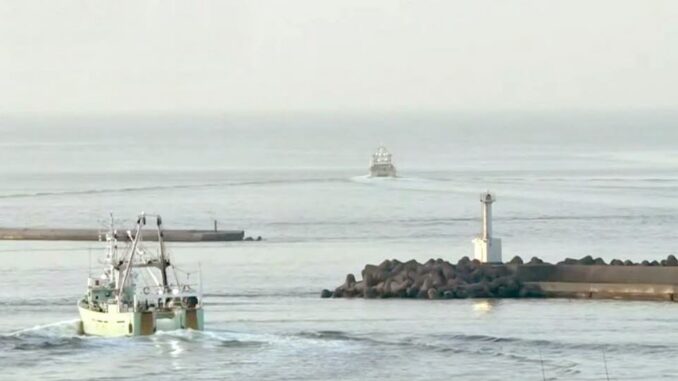
Earlier, the agency issued a tsunami alert and warned that wave damage was expected. “Immediately evacuate coastal and waterfront areas to a safer location, such as higher ground or an evacuation building. Tsunami waves are expected to strike several times. Do not leave safe places until the alert is lifted,” she declared, relayed by the NHK television channel which immediately interrupted its programs. Images from NHK did not show immediately visible damage around several Iwate ports. The Prime Minister’s office indicated that it had set up a crisis management unit.
The country is still traumatized by the 9.0 magnitude earthquake of March 2011, which triggered a tsunami, causing some 18,500 deaths or disappearances. This earthquake was triggered on the Pacific coast of Japan, along the Nankai Trench, off the country. This 800-kilometer underwater trench is the area where the oceanic plate of the Philippine Sea slowly slides beneath the continental plate on which Japan rests.
Possibility of a “mega-earthquake”
The government estimates that a mega-earthquake in the Nankai Trench, followed by a tsunami, could kill up to 298,000 people and cause up to $2 trillion in damage. In 2024, the JMA used a new classification level for the first time, an alert on the possibility of a “mega-earthquake” along the Nankai Trench. The JMA lifted the advisory after a week, but it led to panic buying of basic goods like rice and pushed vacationers to cancel hotel reservations.
It issued a second “mega-earthquake” warning for a week in December 2025 after a magnitude 7.5 tremor off the north coast. The December 8 earthquake triggered tsunami waves reaching up to 70 centimeters and injured more than 40 people, without any major damage being reported.
The previous year, the 1is January 2024, a magnitude 7.5 earthquake – which was then the strongest felt in the country for more than ten years – struck the Noto peninsula (center) and caused the death of nearly 470 people. Japan sits at the junction of four major tectonic plates, on the western edge of the Pacific “Ring of Fire,” and is among the most seismically active countries in the world.
The archipelago, which has around 125 million inhabitants, experiences around 1,500 tremors each year. The vast majority are minor, although damage varies depending on their location and depth below the earth’s surface.
Leave a Reply