
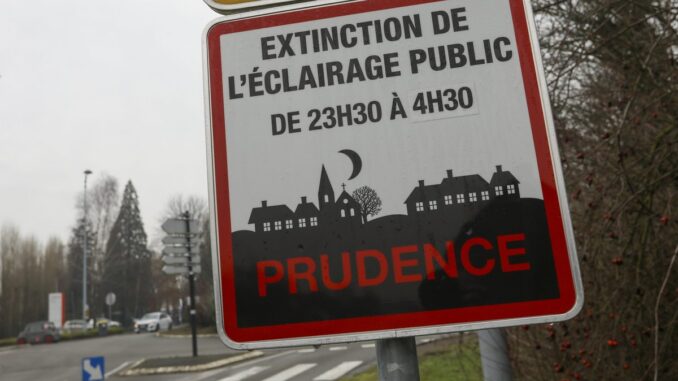
The day after the municipal elections, several mayors decided to relight the street lights that their predecessor had turned off. Public lighting has thus become the subject of debate. Illustration in the region.
They turn the light back on. The day after the municipal elections, several new mayors – mainly from the right – decided to reactivate the public lighting that their predecessor had turned off in recent years. There was Bordeaux, Besançon, Clermont-Ferrand, Poitiers… And in the region, Mende, Carcassonne or Mireval for the first ones. “We will no longer accept that entire neighborhoods remain plunged into darkness under the pretext of so-called sobriety which, in reality, only weighs on the tranquility of the inhabitants.“, thus justified Patrice Saint-Léger, the new Mendois councilor who, symbolically, made it his first measure as soon as elected.“We will restore security, comfort and tranquility““sold” Carcassonne RN mayor Christophe Barthès, saying “respond to a request from residents“.
Wherever the mayor has put his city back in the light – in the literal sense of the term – it is the question of security that has been raised, even though extinction would have no significant impact on delinquency. Also in Mireval, a small town of 3,300 inhabitants where the street lights had been turned off in 2021 between midnight and 5 a.m., at the time “to reduce light pollution harmful to biodiversity“the new mayor Robert André, who pressed the button again on April 2, said “respond directly to the expectations expressed by residents: more security, visibility and tranquility“. In return, he promises to initiate a multi-year plan to modernize the lighting fleet. “to lower the light intensity by 30%“.
Also read:
Light pollution (1/2): “the extinction of nighttime public lighting has no effect on delinquency, opposition is linked to a feeling of insecurity”
Campaign subject
It is a subject that few observers saw coming, but public lighting was invited for the first time into the municipal campaign in many municipalities. In Mauguio for example, the future mayor Pierre-Martin Chazot had slipped “intelligent management, case by case“ among his promises of concrete actions “to live peacefully all year round“.
If the municipal street lamp suddenly became the subject of debate, it is because the previous mandate was marked by a wave of switching off public lighting. Occitanie is even among the three most active regions on the subject with, according to Cerema figures, nearly 42% of municipalities have been plunged into darkness, partially or completely.
Lower the bill
Certainly, the process was started in the mid-2010s by cities wishing to fight against light pollution, but it was amplified in 2022 for an ultimately more pragmatic reason: the electricity bill which was exploding with the energy crisis. “Since 2012, 64% of municipalities with more than 1,500 inhabitants have switched off their lighting and half of them did so after July 2022, mainly for budgetary reasons.“confirms Chloé Beaudet, doctoral student in environmental economics who conducted the first real study on the subject. And these were not penny-pinching savings: the former executive of Carcassonne affirmed last February that the extinction extended in 2023 from 10 p.m. to 6 a.m., “saved more than €500,000 per year“. Not nothing.
The former Carcassonne municipality announced that day that this gain, coupled with “the current stability of energy prices“made it possible to postpone the switching off of public lighting from 10 p.m. to 2 a.m. And she was not the only one to take a step back even before the election. Last summer, it was Nîmes which put the lights back on in peripheral areas “after saving almost €110,000 on the electricity bill“. Above all, insisted the then finance assistant Frédéric Escojido, “further savings are expected over the coming years thanks to the modernization of the 27,000 light points, equipped with low-consumption LEDs“. In Soler, near Perpignan, Mayor Armelle Revel-Fourcade also announced, on February 5, that “the replacement of 600 candelabras with LED equipment makes it possible to achieve significant energy savings, thus allowing them to be lit again all night long“.
A necessary renovation
“The trend has reversed“confirms Agnès Jullian, president of the Biterroise SME Technilum, specializing in urban lighting furniture, which experienced strong growth in its activity in 2024 and 2025. “Today we have devices that are significantly less energy consuming, because they are equipped with LEDs and can be controlled, whether in the cabinet or point by point, which allow savings to be made, but without switching off, which reassures residents. It is possible, for example, to reduce the nominal lighting in the middle of the night, or even to equip certain light points with presence sensors“she unfolds. And to cite the case of La Grande-Motte, which has just completed the renovation of its bright park, “with 90% savings at stake“.
Sufficient, too, to reduce this light pollution? Yes, answers Agnès Jullian, who ensures that the new lighting meets new environmental standards. In Montpellier, an ambitious lighting plan was launched across the metropolis and the replacement of all bulbs with LEDs, coupled with a 50% reduction in lighting intensity from 10 p.m., in addition to the extension of seven major roads and certain municipalities in the periphery and an effort in education and adaptation, made it possible to reduce nighttime radiance by 30% and achieve “several million euros“ savings. And, here, the subject has not polluted… the municipal debate Proof that we can reconcile the defense of living things and a feeling of security, but on condition that we put in the means.
The “radiance” indicator
A map of Cerema, showing changes in public lighting practice at municipal level since 2014, allows us to better measure the effects of the decisions of each municipality on the halo it produces. We can indeed see the evolution of nocturnal radiance over ten years, that is to say the quantity of light emitted during the night and visible from space. An example? At the end of 2024, the lights plan for the city of Montpellier already seemed to be producing its first effects, with a radiance of 18.2 nW/sr/cm², compared to 27.1 five years earlier. It is still high, but the size of the city explains it, it is also the most significant source of light pollution for the Cévennes National Park located more than 60 km away as the crow flies. In Nîmes, the renovation of the lighting park had also already made it possible, in 2024, to reduce the radiance, from 21.1 to 12.3 nW/sr/cm² in five years. Same evolution in Béziers (from 12.4 to 9.2 nW/sr/cm²) or Alès (from 11.6 to 9.4).
This map also shows that switching off public lighting produces effects on this nocturnal radiance. Still in Gard, in Barjac, it went from 4.3 nW/sr/cm² to 1.7 in one month, in November 2020 when the mayor pressed the button. It is even more spectacular in Cazouls-les-Béziers, in Hérault, where the choice to turn off the street lights was made in 2017, making it possible to lower the nighttime radiance to 2.2 nW/sr/cm² in 2024, compared to 8.3 seven years earlier. The city of Millau, which reconciled extinction and renovation of its park, even fell to 3.5 nW/sr/cm², compared to 7.4 at the start of the mandate. So many examples which show that it is possible to take concrete action on light pollution.
Leave a Reply