
Include or not include Donald Trump. That is the dilemma that European leaders currently face, immersed in the design of a plan to facilitate and ensure maritime traffic through the Strait of Hormuz once the war ends. That is, when—and if—the United States and Iran finally manage to reach a peace agreement in a new round of negotiations that, hopefully, ends better than the first.
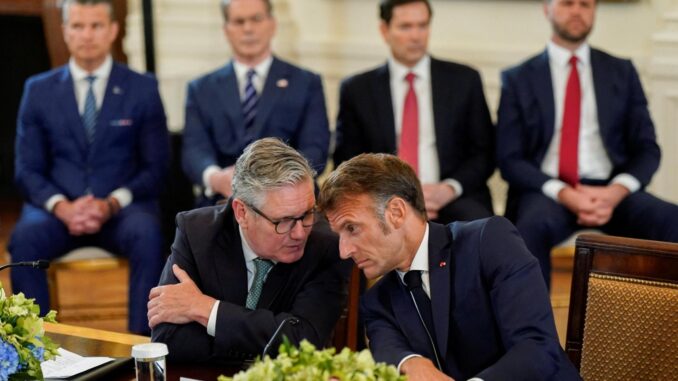
The French president, Emmanuel Macronand the British Prime Minister, Keir Starmerare the promoters of this great coalition, which will begin to take shape on Friday, when leaders from 40 countries willing to contribute join a multilateral videoconference. However, for the initiative to go ahead, Europeans will first have to resolve some differences.
This Tuesday, Macron explained in a statement that the international mission is defensive in nature and does not include “to the belligerent parties”. That is, neither to the United States, nor to Iran nor to Israel. And that is where the friction point is.
United States President Donald Trump attends UFC 327 at the Kaseya Center in Miami, Florida, USA, on April 11, 2026.
As explained to Wall Street Journal (WSJ) European diplomats close to the talks, the French, who appear to be leading military planning, do not want no participation because they believe it would make the operation less acceptable to Tehran.
The British, on the other hand, at the forefront of diplomatic channels, are worried about whether President Trump gets angry for having been excluded and ends up limiting the scope of the operation. The fears are not unfounded. Shortly after the war began, the president asked his NATO allies to join a military operation to reopen the strait, through which a fifth of the world’s oil supply normally passes.
The allies then rejected it for the first time so as not to be dragged into the conflict. Some, like Spain, even denied him the use of their military bases.
Trump then attacked his partners, whom he described as cowards, and urged them to go look for his oil themselves. Later, he discussed with the Secretary General of the Atlantic Alliance, Mark Rutte, the possibility of removing the United States from the organization. An idea that, on the other hand, has been around for some time.
Then came a second refusal just a few days ago. After the failure of negotiations with the Iranian regime in Islamabad, in the midst of a temporary two-week ceasefire, the Republican announced on his favorite platform, Truth Social, that his Army was going to block the strait and Iranian ports to, in theory, suffocate your economy. And he also said “that other countries were going to participate,” although he neither clarified which powers they were nor has any of them commented on the matter. At least to date.
European leaders, with more or less nuances, remain convinced that their priority is decongest and secure trafficand not restrict it further. The key is in the how. It will be precisely the measures to be adopted that will be addressed on Friday at the virtual summit. The exact content of the plan is unknown, but from various sources, such as those collected by Reuters or the WSJ, the roadmap is structured into three critical phases.
Release, demine and secure
Firstly, efforts will focus on establishing the necessary logistics to free the hundreds of freighters that are currently trapped in the Persian Gulf. The priority will then be to begin a complex demining operation to clear the explosive charges placed by Iran at the start of hostilities and thus ensure that the sea route is passable again.
Finally, the fundamental objective of this international mission will be to return certainty to global trade. To this end, the possibility of deploying a surveillance system and regular military escorts—composed of frigates and destroyers—is being explored so that shipping companies regain the confidence necessary to operate in the area. In this context, some information maintains that the plan contemplates the imposition of economic sanctions against Iran if it persists in blocking this vital energy artery.
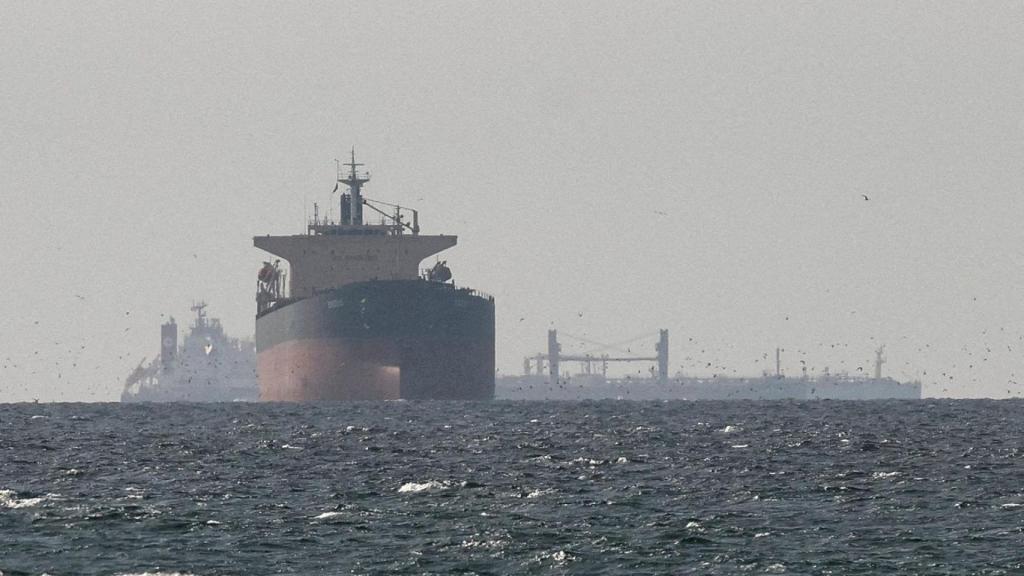
Cargo ships in the Gulf near the Strait of Hormuz.
Reuters
Bridging the gap, this mission is structured around two key precedents. The first is the “coalition of the willing”, also launched by London and Paris to send troops and guarantee the security of Ukraine after the war. But the clearest reference is the Operation Aspidesthe European naval force that since 2024 has been protecting ships in the Red Sea against Houthi attacks with the participation of countries such as Italy or Greece.
That initiative operates independently of the United States’, Operation Prosperity Guardian. And, in fact, some countries have raised it as a possible “Plan B” in case the new scheme does not give results. And the EUNavfor Áspides mission already covers from the red sea to the Persian Gulf and the Indian Ocean, so simply extending its operational radius would strengthen the protection of commercial transit in the strait.
Germany, key partner
Although the final list of attendees for this Friday’s summit has not yet been made public, the participation of at least the 39 nations that signed a joint declaration condemning the Iranian blockade on March 19 is anticipated.
In that document, the signatory countries already expressed their “full willingness” to collaborate in international efforts to restore safe passage through the Strait of Hormuz.
Among the members of this bloc, which already held a first telematic meeting, are powers and strategic partners such as Germany, Italy, Japan, the United Arab Emirates, South Korea and Chile.
Spain does not appear at the moment in the list of participants nor has it shown signs of wanting to join the initiative. According to sources from the Ministry of Foreign Affairs consulted by the Efe agency at the end of last month, Madrid’s position stands firm on the premise of “doing nothing that contributes to the current war.” With this decision, Pedro Sánchez’s Executive appears to continue prioritizing a strategy based exclusively on “de-escalation, dialogue and strict respect for international law.”
Countries included in the joint declaration
United Kingdom, France, Germany, Italy, the Netherlands, Japan, Canada, the Republic of Korea, New Zealand, Denmark, Latvia, Slovenia, Estonia, Norway, Sweden, Finland, Czech Republic, Romania, Bahrain, Lithuania, Australia, United Arab Emirates, Portugal, Trinidad and Tobago, Croatia, Bulgaria, Kosovo, Panama, North Macedonia, Nigeria, Montenegro, Albania, Marshall Islands, Chile, Moldova, Greece, Somalia and Slovakia.
This is a purely diplomatic position that is unmarked of the military aspect of the mission led by France and the United Kingdom.
As reported by a French official to the WSJ, India and China have also been invited to the summit, although their attendance remains uncertain. In any case, beyond the possible incorporation of these two Asian powers – the main consumers of the crude oil that transits through Hormuz – the eventual participation of Germany also stands out.
On the one hand, because it has key resources for the operation, such as surveillance capabilities and vessels specialized in demining. On the other hand, because it faces strict constitutional limitations for this type of deployment, so that any participation in a mission in Hormuz would require the authorization of Parliament, also backed by a solid international mandate, which would contribute to reinforce and legitimize the relevance of the operation.
A “European NATO”
In reality, the coalition to guarantee trafficking in the Middle East constitutes a new attempt by Europe to demonstrate to Donald Trump’s Administration that it is willing to assume a greater role in its own security, beyond the American umbrella, especially after the repeated threats of the White House to leave NATO.

In parallel, an alternative plan designed so that Europe can defend itself using the military structures of the Alliance in the event of a possible withdrawal of the United States has begun to gain strength. This approach of “strategic autonomy” has received a decisive boost after achieving the support of Germany, which had historically been reluctant to promote initiatives outside of Washington, according to the British newspaper.
The officials in charge of coordinating this project—which some already refer to as the “European NATO”—work with a double objective: to reinforce the presence of European commanders in key positions of the Alliance and supplement resources US military with its own capabilities.
Leave a Reply