
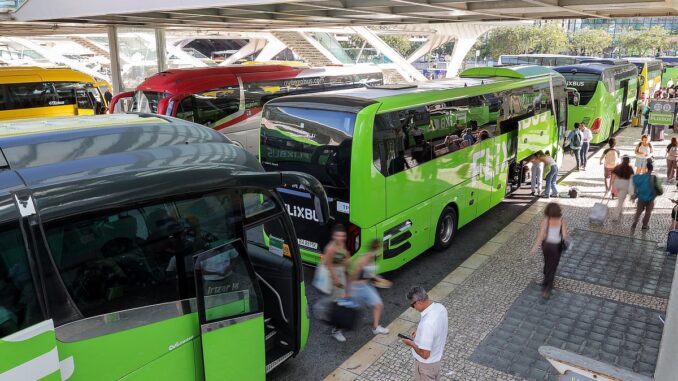
Parliament approved this Friday (April 10) in general an IL bill to prevent bus terminal management companies from being associated with public transport operators.
The proposal was approved with the favorable votes of PS, IL, Livre, PAN and JPP, abstention of PSD, Chega, CDS-PP and BE and the opposition of PCP, and now goes down for discussion in the specialty, in the Infrastructure, Mobility and Housing committee
In the bill, the liberal bench says it wants to put an end to a “clear conflict of interest” that arises when “terminal operators are themselves express service providers” and prevent access to competing companies.
The initiative was announced on March 10, the same day that the Administrative Court of the Lisbon Circle ruled in favor of FlixBus in the case it filed against Rede Nacional de Expressos (RNE), determining “the immediate granting of access to the Sete Rios Bus Terminal”.
The Liberal Initiative wants bus terminal operators to now have to make a decision regarding a request for access to their facilities within a maximum period of 15 days, instead of the current 30, and intends to prohibit any “group relationship” between interface operators and operators of public passenger transport services”.
The party wants that, in cases where public service operators and terminal owners belong to the same company, the concession contract be awarded through a bidding process that ensures “equitable, non-discriminatory and transparent conditions, open to interested interface or terminal operators”.
The liberal bench also proposes that the Competition Authority (AdC) be given “sanctioning responsibility for matters that affect competition in the management of express bus terminals”.
In the explanatory memorandum accompanying the diploma, the party says that “current law allows express service companies to have the possibility of denying access to public facilities to their competitors” and considers it evident that, in a competitive market, the decision to “approve or reject the use of bus terminals and interfaces by new companies should not be the responsibility of those who have economic interests in the occupation of that same terminal”.
Flixbus moved forward with the action in November, asking “for the applicant to be immediately granted access to the Sete Rios Terminal (in Lisbon), under conditions of equality and non-discrimination in relation to other operators”.
The court ruled “the immediate granting of access to the Sete Rios Bus Terminal, limited to the capacity (effectively) available at the terminal”.
To this end, it determined that the RNE must “indicate the availability of docks and parking, specifying the quantity (effectively) available vs occupied”, evaluate “each time slot requested by FlixBus, clearly indicating which times can be accommodated and which cannot, with objective justification” and “assign concrete stopping times according to the (effectively) available capacity, with the possibility of resorting to partial approval, without unjustified global refusal”.
Rede Expressos claimed that the court does not determine the automatic entry of the competitor into the infrastructure.
Leave a Reply