
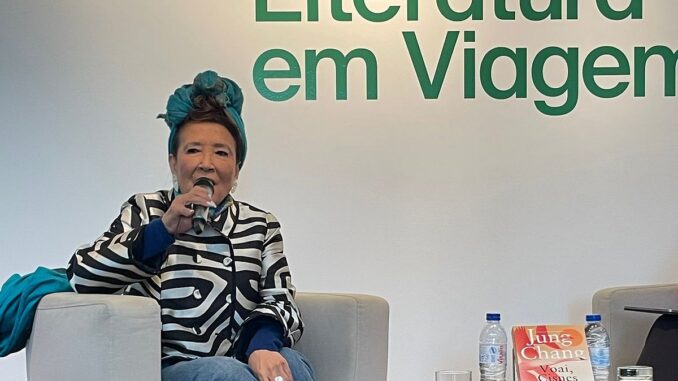
After the enormous success of Wild Swans which Jung Chang published in 1991, thirty-four years later the writer returns to the saga and launched last year what can be called a sequel to this biography of three generations of women from a Chinese family: the grandmother, the mother and the daughter. The sequel does not dispense with part of the title that made this odyssey known throughout the world and is titled Fly, Wild Swans. This time to The narrative begins in 1978, the year in which the previous volume ended and a new era in Chinese government leadership began with the succession of Mao Zedong by Deng Xiaoping. The year Jung Chang was also part of a group of 14 students authorized to study in London.
He was 26 years old when he arrived in the British capital and says it was like “landing on Mars”. So, I wanted to discover a whole world that I didn’t know about and my curiosity remains the same, because upon arriving in Matosinhos to participate in the meeting session Travel Literature his first request was to take her for a walk and see the place where she was. A conversationalist, Jung Chang does not avoid any subject because China is a subject without borders for the author. The only problematic issue is not being able to visit the people’s republic because she is afraid that they will allow her to enter but not let her leave.
There is no shortage of family life stories in this sequel, however, this time the focus is less on the grandmother and more on the mother and herself, along with China. The father is also one of the protagonists of this story, more remembered than in the previous book, especially because the author wanted to add several previously unrevealed parts. It is impossible not to question Jung Chang about whether there will be a third book, as much as he seems to have yet to tell, to which he responds: “I don’t know, after all my mother is still alive and I hope I can see her again. Not that I believe in that possibility with great faith, but you never know because the situation is changing in China.” It is countered, in an ironic tone, that the author herself also does not facilitate a good relationship with the country’s authorities due to what she writes in her books. Chang agrees: “I tell the truth and the authorities don’t like it. It wasn’t always like this and for many years I was always allowed to enter China, so much so that in 1990 I interviewed several people to write Mao’s biography and there was great freedom. It was an extraordinary moment and a great opportunity to speak to people from Mao’s generation who were still alive, as well as many families. It was a time when they spoke freely, when China was freer than it is today, which is why my husband, Jon Halliday, and I had collected a lot of testimonies and managed to do the necessary research for the biography.”
The publication of Mao’s biography once and for all interrupted the passivity of Chinese authorities towards Jung Changas he recalls: “At first, biography was completely prohibited and I was under close supervision, but there was still a certain level of freedom when compared to the current situation, as Xi Jinping is tougher, of a different line and determined to maintain the monopoly of power, in addition to making a point of reviving the image of Mao, who is a genuine follower unlike previous leaders. You saw that line when you deprived Hongkongers of their freedom and went where your predecessors had not gone. In fact, I was invited to the Macau literary festival in 2018 and I received a warning not to go because the National People’s Assembly was going to take place and it was a very tense moment. Xi Jinping sees himself as a true successor to Mao and I am of the opinion that this is what he really wants.”
Jung Chang’s trip to London was a time of hope for him and he never considered the possibility of not returning to China. He explains: “It was the beginning of a time that I had been waiting for for a long time, the end of Mao’s tyranny and the opening of Deng Xiaoping with a set of reforms that promised hope and great optimism for the future of the country. So much so that after my doctorate I returned to China, however, when the massacre in Tiananmen Square occurred in 1989 and after Xi Jiping came to power the situation changed a lot. However, he spent more than a decade under his government and was unable to achieve his goals because he encountered a lot of resistance. and it was necessary to make several compromises. Which gave me new hope, as his ambition is well known, however, this Xi Jinping is not the one from the beginning.” Arriving in London, where he continues to reside, allowed Jung Chang to see a totally different world. But there are two views that please him most: “Nobody wants the world to be the same and I like different cultures. Of course, in my house I have art and Chinese food, but London is where I live and I really like England. It’s the country of my choice, generous and tolerant, which doesn’t stop me from wanting to go back to China to see my mother.”
It won’t be easy to read the sequel in China Fly, Wild Swans because the writer’s books are banned. Although they are not published, it is possible to read them in clandestine translations that are made in the country and also in editions published in Taiwan. Jung Chang comments: “In Taiwan I have many thousands of readers and in China there is no shortage of pirated editions, both Wild Swans as well as Mao’s biography and are even advertised on the internet. With new technologies it is impossible to carry out very efficient control.” Chang does not fail to mention in his new book that being a writer is a very difficult profession in China: “And it remains so, even though it is not comparable to Mao’s time, when almost all writers were convicted, sent to gulags, driven to suicide or even executed. Now, there are still many restrictions on what one can write but there is more freedom, especially if it is about food or clothing. However, the door that has been opened cannot be closed again. This gives me hope and no matter how much the regime tries to block the past because the most new ones, if they want, can meet him.”
Writing took hold of Jung Chang from a young age, even if it was through a poem that would be quickly destroyed to avoid problems. Remember: “From an early age I liked writing, but I suppressed this desire, as all writers were in danger. While working in various professions, an electrician, for example, I realized that mentally I was always writing. Only in London could I really do this, However, I didn’t want to write to avoid looking and thinking about the past. I wanted to forget China and enjoy life, but it was my mother who inspired me when she came to me and told the stories of my grandmother, her and my father and the family. She stayed with me for six months and we recorded 60 hours of conversations, which made me want to be a writer again, so much so that two years later I published Wild Swans.”
In this sequence, Jung Chang’s father has his own space because, he says, “he was always very present in the lives of these three generations of women”. The mother also gains a lot of importance again because “she continues to surprise me with the conversations we had”. I conclude that with this Fly, Wild Swans discovered “many stories that were left unrecorded before” and even hesitated whether it would be necessary to review the first book but no, “after all Wild Swans It’s a personal story and not a story about a regime.” One wonders if readers see her as the writer of Wild Swans or the biography of Mao and the answer is quick: “Always Wild Swansthis is the story that interests my readers most.”
Leave a Reply