
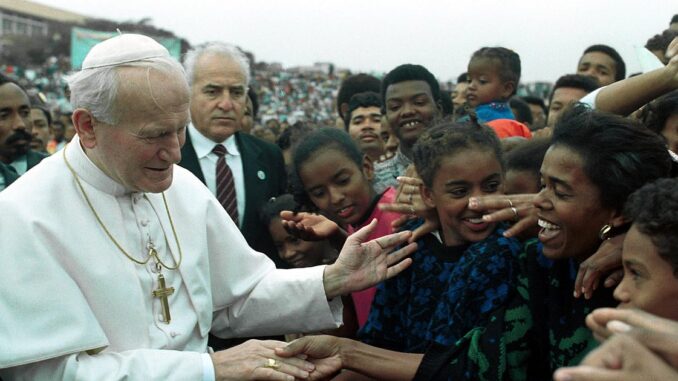
The DN report followed the pope’s visit to the hut of a peasant couple and their eight children in Banzacongo, as it was then written, or M’banza Congo, in the province of Zaire. The pope offered an envelope with 500 dollars to the “moved” father, while the children, with amazed eyes and almost unable to speak, overwhelmed with emotion”, responded, “stammering”, to Wojtyla’s questions.
New Ratzinger Controversy
Benedict XVI’s trip to Cameroon and Angola, in March 2009, was marked by the words he said on the plane on the way to Yaoundé. “Benedict XVI guarantees that the use of condoms worsens AIDS in Africa” was how DN on the 18th reported the German’s controversial statements. “The AIDS problem cannot be solved by distributing condoms. On the contrary, their use worsens the problem”he sentenced during his first of two trips to Africa.
Incendiary statements, considering that, at the time, 67% of the 33 million people infected with AIDS lived in sub-Saharan Africa. “His position reveals that religious dogma is more important to him than the lives of Africans,” said Rebecca Hodes, from the NGO Campaign Action and Treatment.
For the Vatican, the pontiff was saying nothing new, as the official position was one of abstinence and fidelity. In Portugal, the Bishop of the Armed Forces Januário Torgal Ferreira did not silence the disagreement. “Of course there are circumstances, and from a medical point of view I have no doubt, in which prohibiting condoms is consenting to the death of many people”he stated.
The controversy created by Joseph Ratzinger led DN to remember some previous ones, such as a quote he made criticizing Muhammad in 2006, or when he reversed the excommunication of a bishop who denied the Holocaust.
In front of President José Eduardo dos Santos, Benedict XVI gave “a succulent speech”, as commentator Manuel Vilas-Boas classified it on the pages of DN. On the occasion, the Pope drew attention to the “multitude of Angolans who live below the poverty line”, and called for a functional country, with “a transparent government, an independent judiciary, free media” and the “firm determination to put an end to corruption once and for all”..
Former President Mário Soares, DN columnist, did not pass on Ratzinger’s message in Luanda, where he “found words that fell right into the hearts of Angolans”. And he noted “a stark contrast with what happened in Portugal”, during Eduardo dos Santos’ visit, where “there was a general, very unpleasant subservience”.
But the controversy he had been involved in over condoms left this speech overshadowed, as DN noted in an editorial. “It is bizarre that another issue, unfortunately as African as corruption, has received less reaction from public opinion, when it is to be welcomed that the Pope has made his criticism”, read the March 22nd edition.
The visit was also marked by the death of two young people, crushed while trying to enter the Coqueiros stadium, where the pope met with young people. Vilas-Boas witnessed the “lack of interest of many young people who were not at all in agreement with the words of the head of the Catholic Church”. The following day, it was estimated that the mass celebrated on the Cimangola terrace brought together a million people.
It should also be noted that the Angolan government offered at the time the construction of a basilica and the rehabilitation of the entire area around the church of Nossa Senhora da Conceição da Muxima, from the 17th century, having revealed the model to the Pope. The DN envoy to Angola said that the architectural project was by the Portuguese-Angolan Júlio Quaresma, born in Saurimo. Interestingly, Leo XIV’s visit stopped not only at the sanctuary of Muxima, 130 kilometers from the capital, but also in Saurimo, in the east of the country.
Leave a Reply