
The keys
nuevo
Generated with AI
nuevo
Generated with AI
In an increasingly hostile international context marked by the growing aggressiveness of the United States of Donald Trump and China, the European Union cannot allow the vetoes of some Member States stop their ambition to become an independent power, starting with the economic field.
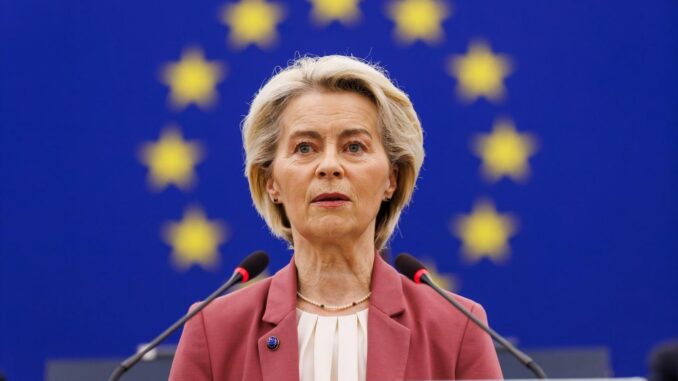
This is the argument that the president of the Commission, Ursula von der Leyenhe wields to defend his bet for a Europe at various speedswhich had been a taboo during his first term, conditioned by the constant search for consensus at 27 and the lowest common denominator.
“Our ambition must always be to reach an agreement between the 27 Member States,” begins Von der Leyen in her letter to European leaders before the informal summit this Thursday at Castle Alden Biesen (Belgium), dedicated to strengthening the competitiveness of the EU.
“However, when the lack of progress or ambition puts Europe’s competitiveness or its ability to act at risk, we must not shy away from the possibilities provided for in the Treaties for reinforced cooperation,” maintains the President of the Community Executive.
Enhanced cooperation allows a group of at least 9 Member States advance in a specific area even if the rest do not want to participate, always within the EU framework and respecting its general objectives.
It is about forming a hard core, a vanguard of countries willing to accelerate integration in areas such as defense, security and justice or taxation and social affairs. Those furthest behind would always have the possibility of returning to the leading group if they wish.
The ultimate objective is to allow the EU to continue progressing even without consensus at 27, avoiding the blockages of those who resist action and thus promoting a flexible integration.
Although it is explicitly contemplated in the Treaties, enhanced cooperation has been activated very rarely and for secondary political initiatives. Its most recent use was the loan of 90 billion to Ukraine, from which Hungary, the Czech Republic and Slovakia were left out.
Von der Leyen proposes resorting more regularly to Europe at various speeds, the formula that at the time made the euro and the borderless Schengen area, this time prioritizing economic integration.
In this area, the “protectionism” of the small Member States led by Ireland and Luxembourg -which fear losing their status as financial centers in the EU- has so far prevented progress in the Capital Markets Uniona project started 10 years ago without tangible results.
The president launches her proposal just after the large EU countries – Germany, France, Italy, Spain, Poland and the Netherlands – launched a joint initiative to “build a stronger and more resilient Europe“At the moment, coordination is focused on the Ministers of Economy.
“In such an uncertain world, we must act together and with agility to be more competitive and more autonomous,” said the Minister of Economy, Carlos Bodyafter the first meeting held on January 28.
The group, which brings together the continent’s largest economies, aims to “generate political momentum to strengthen the competitiveness and strategic autonomy of the European Union in the face of a changing geopolitical landscape.”

Mario Draghi and Ursula von der Leyen, during the presentation a year and a half ago of the report on the European economy
“Among the initial priorities discussed are the need to advance the Savings and Investment Union, strengthen the international role of the euro, improve the efficiency of defense spendingdeepen the integration of the single market and strengthen the resilience of the supply chains of critical minerals”, as reported by the Ministry of Economy.
In fact, the president of the Government, Pedro Sanchezis another of the proponents of asymmetric integration. “Always From the Government of Spain I have defended that, if there is not unity among 27 Member States regarding this integration process, then let’s do it at different speeds“.
“But now is the time for Europe to make that decision to make that integration in all those policies that can make us count and have weight and a clear and influential voice in a geopolitical context that is changing,” says Sánchez.
Also the former president of the European Central Bank (ECB), Mario Draghiauthor of an influential report on how to improve the EU’s competitiveness, has in recent days defended multi-speed Europe as the way to overcome the current stagnation of the integration process.
“I called him pragmatic federalism“Draghi said last week in a speech at the Catholic University of Louvain, where he received an honorary doctorate.
“Pragmatic, because we must take the measures that are possible today with the partners who are willing to do so today and in the areas in which progress can currently be made. But federalist, because the objective we pursue is ambitious,” he maintains.
“This approach allows you to get out of the current block without subordinating anyone. Member States join voluntarily. The door remains open for others, but not for those who compromise the common goal. We do not have to sacrifice our values to obtain power,” argues the former Prime Minister of Italy.
“The euro is the most successful example. Those who were willing to do so took the first step, creating common institutions with real authority and, thanks to that shared commitment, forging a solidarity deeper than any treaty could have imposed. Since then, nine other countries have decided to join.”
“The path will not be without difficulties. As Schuman stated in 1950, Europe will not be done in one go. Not all countries will participate from the beginning in all initiatives – whether in energy, technology, defense or foreign policy -. But each step must remain anchored in the objective: not a more flexible cooperation, but an authentic federation,” Draghi said.
The former president of the ECB will participate in the informal meeting of European leaders on Thursday together with the author of the other reference report on the European single market, the also Italian Enrico Letta.
“Europe risks being subordinated, divided and deindustrialised, all at the same time. And a Europe incapable of defending its interests will not be able to preserve its values for a long time.” A clear and urgent warning that Draghi gave in his speech and that he will repeat before the leaders of the 27 member states.
Leave a Reply