
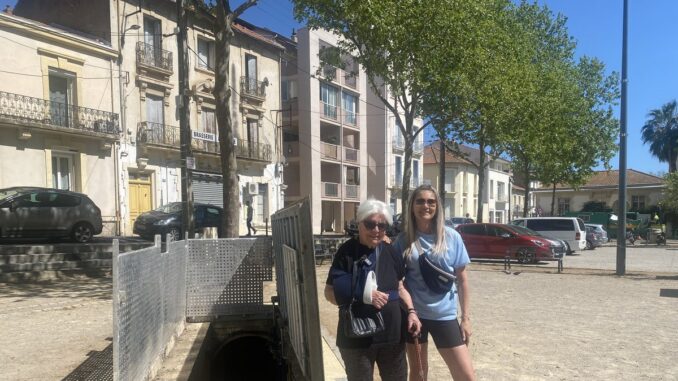
In 2020, air raid shelters dating from World War II were unearthed on Place Émile-Zola in Béziers. It allowed civilians to protect themselves during bombings. Among them, Jacqueline Cauquil, 5 years old at the time. She returns, for the first time, to these tunnels and tells the story.
With her cane, she points out this parking lot which was not there a few years ago, the apartment where she lived, rue de la Liberté, near a butcher’s shop which has disappeared, and the old music school which now houses the OPH offices. In Béziers, on the Place Émile-Zola, or “the square” as the old-timers still call it, time has passed in the shade of the plane trees. “It’s changed a lot,” says Jacqueline Cauquil, looking for the entrance to the air-raid shelter, which, 82 years ago, saved her life.
She is one of the last witnesses of the bombings of the Second World War which affected Béziers in 1944. Jacqueline Cauquil, born in 1939, was 5 years old at the time. This April 17 afternoon, she agreed to return for the first time to this air raid shelter, to testify and pass on her story. Guided by Serge Boyer, tour guide at the City of Béziers who tours – on request – these air raid shelters discovered in 2020.
“At each detonation, she jumped”
“With each bombing we heard, we said to ourselves, ‘the next train is for us’.” says, with a smile, Jacqueline Cauquil. In July 1944, Béziers was bombed by the Allies – English and American – who mainly targeted the station. The objective is to paralyze the railways to prevent the German army from sending troops to Normandy. “There were open trenches. The two underground shelters, each 40 meters long, were built in a disaster between April and May 1944”explains Serge Boyer. 250 people could fit in these cramped tunnels, “and built with right angles in order to cut off the blast of bombing in case the entrance is hit”, details the guide.
Carefully holding the arm of Clémence, her granddaughter, Jacqueline descends the stairs which lead to the underground and cuts off the world. Emotion seizes her without erasing her cheekiness. “I remember perfectly, I was at the entrance to the shelter, my grandmother was in front of me. In front of the entrance, there were two soldiers.”, she says. The stairs, on the other hand, mean nothing to her and suggest that she was in the other shelter. “I wasn’t really afraid, at 5 years old I don’t think we are aware of death”, she thinks. “I was very worried about my grandmother, she was a person I particularly loved, I adored her, and we knew she had a heart problem. She was afraid, at each detonation, she jumped and pressed herself against the wall”she says, sitting in the same place as 82 years ago, imitating her grandmother.
Continue to pass on these stories
“Do you remember the atmosphere inside the shelter? The noise, people talking, or on the contrary the silence?” Clémence has a thousand questions to ask her grandmother, this visit is also a matter of transmission. “I find it very interesting from a historical point of view, many people don’t know that Béziers was bombed. Soon there will be no more testimony, it’s precious.” She helps her grandmother reconstruct the stories she already heard as a child: like Jacqueline’s father who was a prisoner in Germany but who, thanks to his mastery of German, was able to escape by posing as a soldier.
Once the war ended, post-war society attempted to sweep away this period: “For a long time, we didn’t talk about it, neither the war nor the shelters, but I thought about it”remembers Jacqueline. Serge Boyer confirms this impression: “Béziers was liberated on August 22, 1944, and at the beginning of September, we closed access to the tunnels, we wanted to forget.”
Today, if we are to believe the enthusiasm of the workers present on the square, who dropped their tools for a few minutes, intrigued by the appearance of the tunnel and Jacqueline’s story, this part of history and these direct testimonies continue to interest the Biterrois.
Leave a Reply