
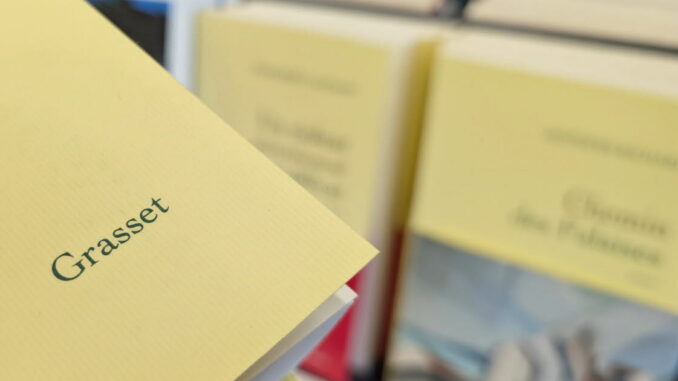
The departure of Grasset CEO Olivier Nora is causing turmoil in the publishing world. Blamed by several authors on the billionaire Vincent Bolloré, it led some 170 writers to announce, this week, their refusal to publish new works with the publishing house, a subsidiary of the Hachette Livre group, controlled by the conservative billionaire Vincent Bolloré.
The latter denounced in an open letter “an unacceptable attack on the editorial independence” of the prestigious house. In a rare speech, Vincent Bolloré attributed this revolt to “a small caste which believes itself above everything, in a column published by the Sunday newspaper, which belongs to him.
In the wake of the announcement of the writers’ departures, more than 300 authors and players in the sector also called, in a forum published by La Tribune Sundayto the creation of a “conscience clause” for the book professions. Asked Thursday at the book fair about the relevance of a conscience clause for authors, Emmanuel Macron replied: “it is in any case something which must be thought about”.
In what cases can it be used?
The conscience clause already exists in French labor law for journalists (article L7112-5 of the labor code). It allows an employee to terminate their contract with compensation when a profound change in the editorial line or the nature of the company undermines their professional ethics. Not to be confused with the transfer clause, which allows journalists to leave their editorial staff with compensation when a media outlet is sold or changes ownership.
The conscience clause “should make it possible, in extremely regulated situations, to recognize that a company has changed its nature to the point of breaking the pact which linked it to those who work there or create there, and to open up a right to compensated departure as well as the recovery of their rights”, we can read in the article.
For example, in 2016, iTélé opened a conscience clause upon the arrival of Jean-Marc Morandini (just indicted for corruption of minors, definitively convicted in January 2026) so that journalists who did not want to work with the host could leave the channel with compensation.
Negotiations to apply it
Last year, around ten journalists from the weekly Marianne exercised their conscience clause, after a motion of no confidence targeting editorial director Eve Szeftel. Even more recently, after negotiations, the system was open until April 30 to the economic magazine Capital, one of the titles of the Prisma media group, taken over by relatives of Vincent Bolloré in 2025.
The conscience clause “must be extended, not to weaken businesses, but to reestablish an elementary balance between the freedom to undertake and the freedom not to serve what we disapprove of,” argue the authors of the column.
However, this right cannot always be used. At JDD in 2023, when Geoffroy Lejeune, straight from the far-right magazine Current valuesis appointed head of the editorial staff, the conscience clause has not been activated. For what ? Because a change in editorial line was not legally established. Several dozen journalists finally left the weekly via a negotiated departure agreement.
Vincent Bolloré defends himself
For his part, Vincent Bolloré counterattacked in a column published in the Sunday newspaper. The conservative billionaire affirms that Grasset “will continue” despite the announced departure of some 170 of its authors, estimating that “those who leave will allow new authors to be published, promoted, recognized and appreciated”.
He was also surprised by the “uproar” caused by the departure of Olivier Nora, denouncing “a small caste which believes itself to be above everything and everyone and which co-opts and supports itself”. In his response, the billionaire mentions a “dispute” with the latter over the publication of Boualem Sansal’s next book, as well as the “very disappointing economic performance” of the house and the increase in the remuneration of its CEO.
“As for the attacks concerning my “ideology”, I remind you once again: I am a Christian Democrat and the leaders of Hachette will continue to publish all the authors who wish to do so,” he concludes.
Leave a Reply