
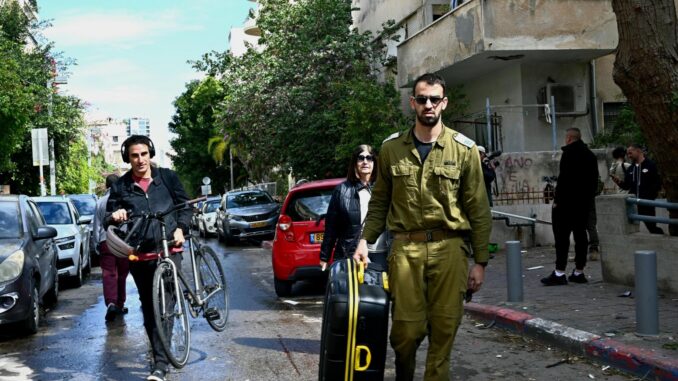
“You don’t have to be afraid. We are safe here. You can stay with me and watch the missiles fall.” That’s how he spoke Sami (a pseudonym for this report) when last Saturday at three in the afternoon the air raid alarms began to sound in Tel Aviv.
In the cafeteria of this Arab-Israeli citizen, located in the Jaffa area, there is no air-raid shelter. But he does not plan to move to a lot (public shelter), which is located within a school that is a three-minute walk away.
“Iran’s missiles don’t make me feel anything. They are just an annoying noise to me. Dying like this is better than dying from cancer. With a missile you die without pain. There is a saying in Hebrew that says: Game to take. Whatever comes from God, it will be good,” he tells EL ESPAÑOL.
Many Israelis seem to feel the same way. Although scarce, traffic does not stop, and there are even those who choose to continue their bike ride while the alarms sound instead of heading to the nearest shelter. Stray cats don’t even flinch before the sound.
There are those who choose to stay outside to watch calmly as the missiles are intercepted. But they are the minority. After a few moments, the streets are deserted as residents take shelter in shelters.
Israel itself is a melting pot made up of many different cultures. On the one hand, the children of the Jewish diaspora from Eastern European and former USSR countries that survived the Holocaust and emigrated after World War II. On the other hand, Jews from neighboring Arab countries such as Iraq, and others more distant such as Morocco, Iran or Yemen.
There is also a significant minority drusawhich is mainly concentrated in urban centers such as Haifa, in the north of the country. And there are also, of course, the arabs. Some of them have Israeli passports, others carry Jordanian ones.
Each group has its own opinion of the war with Iran, although 93% of Israeli Jews are in favor according to a survey conducted by the Israel Democracy Institute (IDI).
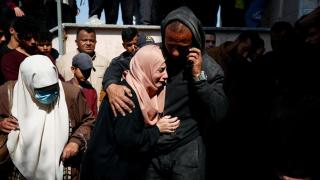
To Nofar Cohena 34-year-old Israeli Jew of Yemeni origin, it is not about whether the population of Israel agrees or not with a long war. “I don’t think there is any other solution,” he says.
“Everyone can see it. It’s not like the war in Gaza or Lebanon. Relations with Iran are too complicated. They are a threat to everyone. They have started launching missiles not only at Israel, but at anyone who gets in their way,” he points out.
Samer says he does not agree with any war even though, as a Palestinian, he is happy that they attack Israel: “I don’t like them, and I have lived through many. I don’t want the war to be long because I don’t want there to be any, it is very bad for the economy. With war, there is no tourism.”
Samer regrets that he is losing a lot of money. He barely has any customers in his premises, and he has to pay about 44,000 shekels (12,000 euros) in rent.
To Eliyahua 40-year-old Israeli who prefers not to share his full name, “Netanyahu is not doing anything, he is just doing what Trump says. He needs this war to win the elections, and he needs it to avoid going to jail,” he comments, emphasizing that it is just his opinion.
This Israeli citizen isn’t that he doesn’t support the war, he just doesn’t like the reason it started: “If they really wanted to attack and had enough uranium to create an atomic bomb, maybe they would have done it. But I’m not sure.”
Eliyahu opines that The war will end when Iran runs out of ammunitionbut not because they manage to end his regime. “As happened in Venezuela, when Nicolás Maduro was kidnapped, but the same system governs there. The same thing is going to happen,” he concludes.
Eliyahu also believes that it is not possible to change the regime in Iran surgically, as was done in the Caribbean country: “Thousands of kilometers away, the only thing they can do is bomb.”
He also finds multiple similarities between the Israeli prime minister and the Russian president. Vladimir Putin.
“In Russia people said, who would lead Russia but Putin? Because he has a lot of experience,” he points out. “What people who support Netanyahu say is very similar to what people in Russia who support Putin said. Who else but Netanyahu? He has been in power for many years.”
“Israelis are tired of long wars. They have been in one for two and a half years and will not support another despite understanding that it is not in the hands of Israel, but depends on Trump and the Iranians. “They will decide the duration of the war,” he explains. Amir OrangeIsraeli political analyst.
The position of the Israelis interviewed for this report (especially the Jews) coincides with the analyst’s opinion. They will support the war as long as it does not extend too long, even though they are accustomed to conflict and consider Hezbollah and Iran a great threat.
The most Israeli society will support the war is another week or two, Oren concludes.
An unequal political cost
The next elections in Israel are scheduled for October this year, and the prime minister Benjamin Netanyahu He is being prosecuted for bribery, fraud and breach of trust in three separate cases.
Those interviewed think that winning the war could benefit them politically. The conflict also relegates its corruption scandals to the background.
“The Israeli justice system has surrounded the Israeli Prime Minister for being corrupt,” he recalls. Dolores Rubioprofessor of International Relations at the Complutense University of Madrid. “Any war is good for it because it throws the issue to the outside.”
The start of the operation Epic Fury marked the beginning of a war that, although it began as a conflict between the United States and Israel against Iran, soon escalated to a regional level, with sixteen countries attacked. Yemen has been the only Gulf country to avoid retaliation.
In recent days, Hezbollah attacked Israel and Israel responded by bombing Lebanon, two missiles heading towards Turkey were intercepted, an Iranian warship was shot down in international waters, and an airport in Azerbaijan was attacked by a drone.
“Many Israelis do not like Netanyahu, not only because of his corruption scandal, but because many hold him responsible for the October 7 massacre,” says Oren.
On the other hand, adds the Israeli analyst, society is disappointed with Netanyahu because, when he attacked targets in Iran in the so-called Twelve Day War in June last year, he assured that he had eliminated the threat forever.
“Eight months later, however, the Israelis have been told that no, the threat has not been eliminated, that perhaps their nuclear project is frozen, but that there are still other latent threats: ballistic missiles from Iran, Hezbollah and the Houthis,” explains Oren.
“So many, many Israelis suspect the political motivation of this war, even if it is not certain that it will be enough to clean up their image,” he adds.
“We know that for Israel this war is an existential conflict. Hezbollah and Israel are mortal enemies,” says Rubio. “While winning this war serves Netanyahu politically, the Israeli economy will be affected by a long conflict: there will be a drop in productivity, and tourism will also be affected for obvious reasons.”
“On the other hand, investment in technology, especially in the military field, will increase,” he emphasizes.
Although many experts believe that Trump is looking for a quick outcome, Rubio is not convinced: “What he wants is to win, and it is already being said that he wants to operate like in Venezuela, that is, not so much to overthrow the regime, but to appoint someone who will open the doors to Gulf oil for him.”
In the United States, the cost of the war is already being felt in the pockets of Americans, with the increase in electricity and gasoline prices.
“The American economy,” Rubio points out, “is going to suffer the same as the rest of the European countries, but without the possibility of using a social umbrella because it does not have one.”
“For Trump, however, the end justifies the means,” insists the specialist. “Its objective is to implement the doctrine of the greater Middle East under the rule of the United States.
This doctrine consists of including all ethnic minorities in a single religion, Islam, to establish its absolute hegemony or zone of influence.
It is about uniting Asia Minor, Western Asia and South Asia into a single strategic zone, in order to better control it, which would put someone in power in Iran similar to the United States.
The Israeli analyst agrees with Rubio. For him, it is evident that Trump will try to take advantage of the war to get Israel closer to Saudi Arabia, to achieve the long-awaited normalization.
But the price to pay for Israel, Oren remarks, “would be to recognize a Palestinian state, something that Netanyahu will not be able to do, at least in his current political coalition, which he would like to retain after the elections.”
The reasons that lead the United States and Israel to cooperate are different, but both seek victory at all costs: for Netanyahu it is about not only political but existential survival, and for Trump to expand his influence and control in a region rich in natural resources.
Leave a Reply