
Spain will be present at the telematic meeting that will be held this Friday more than 40 countries to address the situation in the Strait of Hormuz, the crossing through which 20% of the world’s gas and oil transit, which remains subject to a double blockade despite the ceasefire and the talks ongoing between Iran and the United States.
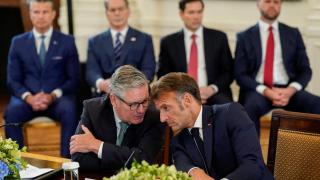
The Minister of Foreign Affairs, Jose Manuel Albareswill speak in the videoconference organized by the French president, Emmanuel Macronand the British Prime Minister, Keir Starmerthe visible faces of the call Coalition of the Willing in defense of Ukraine who are now taking the initiative in Hormuz.
European leaders remain divided over whether or not to include in their plans Donald Trump. Starmer is in favor of doing so; Macron, no.
In addition to the eventual inclusion of the United States, the participants in the meeting will explore the different options available to guarantee transit through Hormuz when the war ends. A scenario that Trump himself began to draw this Thursday.
“I think we have a very successful negotiation right now. That will give us free oil, free passage through the Strait of Hormuz. Everything will be great,” the Republican president declared from the White House, boasting of the improvement of his relations with the new leadership in Tehran.
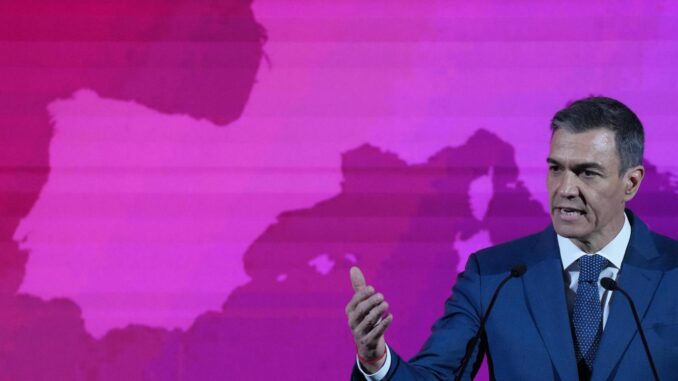
This Thursday, the President of the Government, Pedro Sanchezonce again defended “the right to free navigation”, but ruled out Spain’s participation “in any military operation that may be developed linked to the war in Iran and this includes an intervention in the Strait of Hormuz.”
Moncloa sets two conditions to get involved in the matter: that the war ends and that the operation be carried out “under the umbrella of the UN.”
Sánchez avoided intervening in the first video conference on Hormuz that European leaders maintained in early April, but did sign the joint statement issued a week later after the announcement of the ceasefire between Iran and the United States.
In that note, the signatories urged the parties to move quickly “towards a substantive negotiated agreement” that would serve to reopen Hormuz and avoid “a serious global energy crisis.”
In this sense, the director of the International Energy Agency (IEA), Fatih Birolwarned this Thursday that Europe only has jet fuel for “perhaps six weeks” and that there may be flight cancellations “soon.”
Division
The United Kingdom considers the involvement of the United States in efforts to guarantee movement in Hormuz necessary. Starmer fears irritating Trump, who has denounced the lack of support among his NATO allies since the beginning of Operation Epic Fury, whom he considers “cowards.” The French, on the other hand, are reticent. They prefer to navigate without the ties of Trump, more hostile than usual towards his Alliance partners.
In this context, the French Minister of Finance, Roland Lescuredeclared this Thursday that yes, the Strait of Hormuz must be reopened, “but not at any price”: “I am going to tell you very seriously: I do not want to pay 1 dollar to pass through the Strait of Hormuz.”
Unlike Sánchez, neither Starmer nor Macron have conditioned the mission in Hormuz on the involvement of the United Nations in the matter. The German Chancellor Friedrich Merz It has instead adopted a position similar to that of Spain.
The Christian Democrat leader offered Germany’s resources to secure transit routes in Hormuz when the war ends, provided there is a mandate, preferably from the United Nations, and the approval of the Bundestag.
“We are still very far from all that,” acknowledged Merz, who is exploring providing minehunters of the Type MJ332 class or reconnaissance vessels, and proposing the use of the naval logistics base in Djibouti managed by France.
European leaders, with more or less nuances, remain focused on decongesting and ensuring traffic. The key is in the how. It will be precisely the measures to be adopted that will be addressed at the virtual summit this Friday.
Efforts will focus on establishing the logistics necessary to free the hundreds of cargo ships that are currently trapped in the Gulf.
The priority will then be to begin a complex demining operation to clear the explosive charges placed by Iran at the start of hostilities and thus ensure that the sea route is passable again.
Finally, the fundamental objective of this international mission will be to return certainty to global trade. To this end, the possibility of deploying a surveillance system and regular military escorts—composed of frigates and destroyers—is being explored so that shipping companies regain the confidence necessary to operate in the area.
In this context, some information maintains that the plan contemplates the imposition of economic sanctions against Iran if it persists in blocking this vital energy artery.
Leave a Reply