
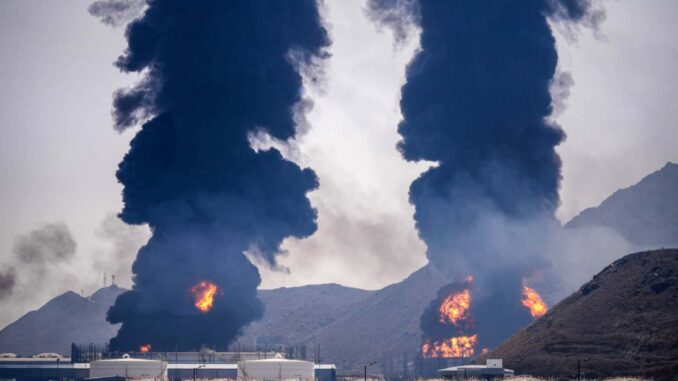
Clouds of smoke and fire at an oil facility in Fujairah, United Arab Emirates
Associated Press/Alamy
Despite Donald Trump’s relentless attacks on climate action, the president gave the Green Revolution a “drill, baby, drill” by attacking Iran.
In response, the Islamic Republic halted almost all traffic in the Strait of Hormuz, a waterway through which a fifth of the world’s oil reserves and a fifth of seaborne gas supplies pass, and struck oil and gas fields with drones and missiles.
The price of oil jumped from around $70 to more than $100 a barrel, and natural gas prices also shot up in most regions. While Arab countries have diverted as much fuel as possible through pipelines, prices are expected to remain high. Even if oil prices fell to an average of $85 for the entire year, it would cost fossil fuel-importing countries an additional $240 billion, according to think tank Ember.
But maximum use of renewable energy, electric vehicles and heat pumps could reduce those costs by 70 percent, the company said.
“The conflict in Iran will almost certainly accelerate the energy transition,” he says Sam Butler-Sloss in Ember. “As prices rise, as awareness of the fragility of the fossil fuel system grows, it’s increasingly clear that nations need to find safer forms of energy, and … everywhere in the world there’s a place where there’s plenty of solar radiation and wind.”
The effects of this energy crisis will be even wider than when the Russian invasion of Ukraine in 2022 reduced the flow of Russian oil and gas to Europe. Since then, annual solar construction has more than doubled in the European Union and increased by around two-thirds in the UK, with wind power also steadily growing. Renewables now account for about 45 percent of global energy capacity.
It is now the most vulnerable region of Asia to receive four fifths of oil and liquefied natural gas (LNG) transported through the Strait of Hormuz. Japan and South Korea rely on the strait for 70 percent of their oil, and a third of Taiwan’s natural gas comes from here. Up to half of India’s oil and natural gas is imported through the strait, and some restaurants there have even had to cut back on food options due to a shortage of cooking gas. “This is an Asian moment in Ukraine,” says Butler-Sloss.
In the short term, greenhouse gas emissions may actually increase as countries like Japan and South Korea begin to generate more power from coal, which is twice as dirty as natural gas. Both countries are also increasing the output of existing nuclear power plants.
But Seoul has also promised to speed up financing, permitting and grid access for wind and solar projects, and Indian Prime Minister Narendra Modi, he said March 11 that solar and electric vehicles will help reduce the country’s dependence on foreign fuel imports.
“Economies in Asia are getting a wake-up call, just as Europe got a wake-up call four years ago,” he says Pavel Molchanov at the investment company Raymond James & Associates. “The wake-up call will push for more renewables in the electricity mix as fossil fuels are once again subject to blackouts.”
Some analysts expect China, which is already installing more solar and wind power than the rest of the world combined, to accelerate that as nearly half of its oil imports pass through the Strait of Hormuz. At the same time, as the world’s largest coal producer, it is likely to increase the share of coal in its energy mix.
“China will follow its long-term energy strategy, which is outlined above,” he says Li Shuo at the Asia Society Policy Institute. “That’s exactly the lesson that many other countries will learn.”
But in countries with poor electricity grids, the rising cost of natural gas and diesel will now make solar power more attractive to both utility companies and villages and households. For example, after the invasion of Ukraine largely pushed Pakistan out of the LNG market, solar power rose from 4 percent to 25 percent of electricity generation there, thanks in large part to households and businesses installing cheap Chinese solar panels.
In the long term, electric cars may be the biggest global winner. Most natural gas is not delivered by ship but by pipeline, so prices may fall sooner. On the other hand, oil is a global market with a global price. Car owners are struggling with incredible prices at gas stations even in the US, which is the world’s largest oil producer.
More will consider buying EVs, and governments should support them, as the “super leverage” of EV deployment could reduce the bills of fossil fuel-importing countries by a third, says Ember.
But with the average lifespan of a car being nearly two decades, it will be years before significantly more electric cars start to appear on the road, he says. Michael Liebreichenergy consultant at Liebreich Associates. The replacement of natural gas electricity with renewables will be seen quickly and will continue even as gas prices fall, he says.
“The assumption of growing demand for gas in a world that has cheap wind, solar and batteries and is increasingly opposed to dependence on global commodity markets, that story is wrong. It’s over,” says Liebreich.
topics:
Leave a Reply