
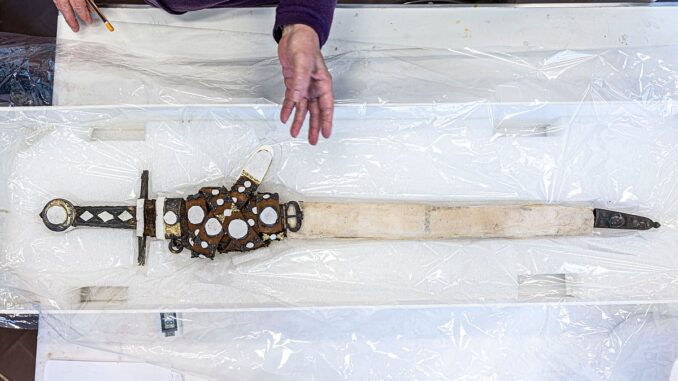
The remains of the tombs of King D. Dinis and Infante, one of his grandchildren, in the Odivelas Monastery, district of Lisbon, were classified as national treasures, according to a decree published this Monday, February 16, in the Diário da República.
The decree highlights the “matrix nature of assets, [o] their interest as notable testimonies of historical experiences or facts, their intrinsic aesthetic, technical and material value, their interest as symbolic and religious testimonies and their importance from the perspective of historical and scientific research and what is reflected in it from the point of view of collective memory, as well as the circumstances likely to cause a decrease or loss of the perpetuity or integrity of the assets and the effective need for protection and appreciation of the set”.
The process was opened in 2023, by the then General Directorate of Cultural Heritage, noting that “the protection and valorization [do espólio do túmulo] represent cultural value of significance to the Nation”.
At the beginning of 2025, the deadline for completing the classification process of the estate of the tomb of King D. Dinis (1261-1325) had been extended until August of that year, having been proposed for classification in July.
D. Dinis’s tomb, in the Odivelas Monastery, in the Lisbon district, was opened in 2020, revealing a sword, a silver buckle and several textiles.
The tomb was closed on June 28, 2023 at the Odivelas Monastery and, at the time, archaeologist Maria Antónia Amaral, one of those responsible for the ongoing study on the monarch and his estate, told the Lusa agency that she proposed classifying the cloak and sword found there as national treasures.
According to the archaeologist, the king’s remains were studied by an Anthropology team, and there is also the collection associated with the monarch and the infant – one of Dom Dinis’ grandchildren, who is also buried in the monastery – that needs to be studied, and analyses, dating, inventories, reports and scientific articles would also be produced.
In the justification of the classification proposal, in a document dated July 2023, the “high heritage interest of the Estate of the tomb of King D. Dinis” was noted, concluding that “it is an unprecedented historical-artistic set, which demonstrates values of memory, antiquity, authenticity, originality, creativity, rarity and singularity”.
In the same decree, a Flemish painting representing Our Lady in a landscape praying before the Crucified Christ, probably Antwerp School, a plaster model of the equestrian statue of José I, by Joaquim Machado de Castro, and two phonograms relating to the password of the 25th of April revolution were classified as national treasure.
In another decree, also published today, the classification as a set of national interest of the collection of the Chapel of São João Baptista of the Church of São Roque, in Lisbon, is confirmed, where “one of the most extraordinary liturgical ensembles from the mid-18th century in Portugal is preserved”.
Leave a Reply