
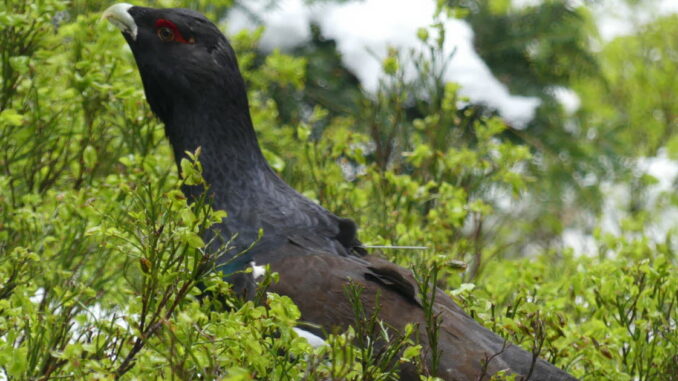
The debate has never stopped since 2024, when the Ballons des Vosges Regional Natural Park decided to organize a translocation operation for Norwegian capercaillies with the aim of strengthening the indigenous population, estimated at only a few individuals.
Many associations
were immediately opposed to this reintroduction, denouncing unfavorable habitats, human disturbance, forest imbalance and climate change, which would have compromised the chances of survival of the Norwegian capercaillie.
High mortality rate
These associations have continually highlighted, over the last two years, the high mortality rate of reintroduced capercaillies. After the first capture operation in Norway, nine grouse were released, and seven of them were killed, mostly by predators, marten in particular. The second capture, carried out in spring 2025, only resulted in the capture of seven birds, translocated to the same place. One of these birds even died upon arrival.
This Friday, April 17, the associations opposed to the reintroduction wrote to the Vosges prefect, this time to denounce the scientific monitoring of this reintroduction, which does not leave room “for the freedom of expression of the actors involved in the project monitoring bodies”. They demand “freedom of speech for actors in the field, the independence of scientific expertise and the sincerity of the decision-making process”.
The scaring devices in question
These associations recall in particular their opposition to the measures envisaged to protect the capercaillie, such as the use of devices to scare away its predators. “For us, this question is central,” says SOS Massif des Vosges. “The quality of public decision-making in environmental matters is based on the independence of opinions and the possibility of a free and contradictory scientific debate. This requirement is all the stronger as the current project is subject to significant scientific reservations. Certain experimental measures envisaged, such as the use of ultrasonic scaring devices, raise questions about their effectiveness and their potential impacts on non-target wildlife,” the associations further emphasize.
In particular SOS Massif des Vosges, Oiseaux Nature, Vosges Nature environment, Future and Heritage 88, Landscape Nature and Heritage of the Vosges Mountains, Lorraine Association Nature (LOANA), Vosges Animal Rescue and Placement Association (ASPA Vosges), Biodiversit’Haies 88 signed the letter to the Vosges prefect.
Source
Leave a Reply