
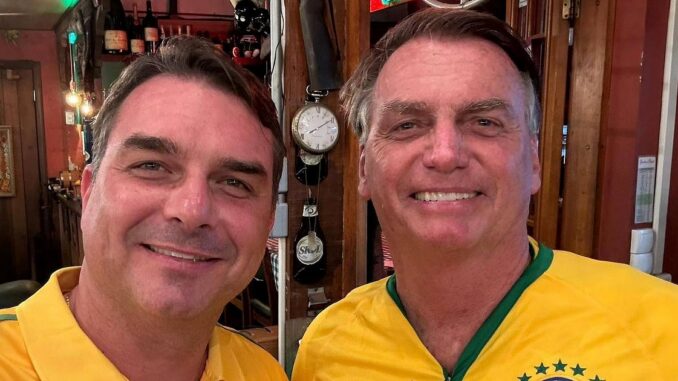
Flávio Bolsonaro has 42 percentage points and Lula da Silva just 40 in a situation of technical draw but, for the first time since the publication of polls for the October elections this year, with a numerical advantage for the far-right candidate, reveals the study by the Genial/Quaest institute on Wednesday, 15. Therefore, Brazil asks itself: what if Flávio, with the support of the other candidates from the conservative camp, actually wins and succeeds Jair Bolsonaro? It would be unprecedented in the country’s history for a father and son to be presidents.
It was already close to happening: Hermes da Fonseca, eighth president of the Republic of Brazil, from 1910 to 1914, was the nephew of Deodoro da Fonseca, the country’s first president, from 1889 to 1891, and one of the authors of the republican coup that overthrew Emperor Dom Pedro II. Like his grandfather Tancredo Neves, nominated president in an indirect election in 1989, his grandson Aécio Neves also came close to reaching the Palácio do Planalto in 2014 but was beaten by Dilma Rousseff.
Political dynasties are very common in Brazil in the regional context – for example, João Campos, favorite candidate for the government of Pernambuco, is the son of Eduardo Campos, governor from 2007 to 2014, and great-grandson of Miguel Arraes, who held the position on three occasions – or at the legislative level – Bonifácio de Andrada, who was federal deputy for Minas Gerais for 10 terms, from 1979 to 2019, belonged to the fifth generation of a clan that ran for 196 years in the parliament, since Ribeiro de Andrada was appointed deputy in the Constituent Assembly of 1821, still in the Lisbon courts.
But father and son in the presidency, as mentioned, never. “If the research that puts Flávio ahead is confirmed, it is a considerable achievement because Jair Bolsonaro, unlike the other cases, does not come from a rich family, that is what in the USA is called poor white trash [escória branca, em tradução livre]perhaps because he electorally represents what I call the penta B, in addition to the traditional groups of Boi (agriculture), Bala (police and military) and the Bible (evangelicals), also the B of whiteness, which he shamelessly defends, and the B of a certain stupidity”, says Vinícius Vieira, professor of Political Science and International Relations at the Armando Álvares Penteado Foundation.
“In India, there is the Nehru-Gandhi family dynasty, in current South America, the most present example of personalism is father Alberto and daughter Keiko Fujimori, in Peru, despite the many differences with these cases, the Bolsonaro are also already an example of a dynasty and an example of personalismperhaps the first with a national dimension”.
“Because after all, Jair’s other children, Flávio’s brothers, and the former first lady Michelle herself have careers and political aspirations, which is why the nickname has already been labeled Bolsonarism, a reactionary, traditionalist, far-right movement that submits to the United States,” he adds.
In the world in general, these cases are rare, but in North America, not so much. In the United States, John Quincy Adams, president from 1825 to 1829, was the son of John Adamschairman from 1797 to 1801, and, more recently, George Bush served in the White House for one term, from 1989 to 1993, and his son George W. Bush for two, from 2001 to 2009, perhaps the most famous and powerful father-son presidential duo of recent decades. Already in Canada, the Trudeaus were in power through father Pierre and son Justin, both prime ministers, not presidents, in one of the rare cases in contemporary parliamentary democracies.
In authoritarian regimes, however, such as in Haiti, under François and Jean-Claude Duvalier, in Syria, under Hafez and Bashar al-Assad, or in North Korea, under grandfather Kim Il-sung, father Kim Jong-il and grandson Kim Jong-un, political heredity is more common.
Returning to Brazil, President Lula (PT), who has no political children, has not yet completely lost favoritism for the October elections. Easily beat all other opponents in the second roundRomeu Zema (Novo), Ronaldo Caiado (PSD), Renan Santos (Missão), the three on the right, and Augusto Cury (Avante), who does not classify himself ideologically.
In relation to Flávio (PL), the current president had a 10-point lead in December, went up to seven in January, five in February and tied at 41 points before last week’s two-point deficit. “The economy’s macro numbers are good but the population’s micro perception is not, and it is this factor that has harmed Lula’s performance compared to Flávio”, said Felipe Nunes, CEO of Quaest, on the Globonews channel.
In the first round, 37% of those interviewed voted for Lula against 32 who preferred Flávio. At long distance is Ronaldo Caiado, with six, Romeu Zema, with three, Augusto Cury and Renan Santos, with two, Cabo Daciolo, from Mobiliza, center-right, and Samara Martins, from Unidad Popular, far-left, with one point. Aldo Rebelo, from the right-wing Christian Democracy, does not score. There are 5% undecided.
Leave a Reply