
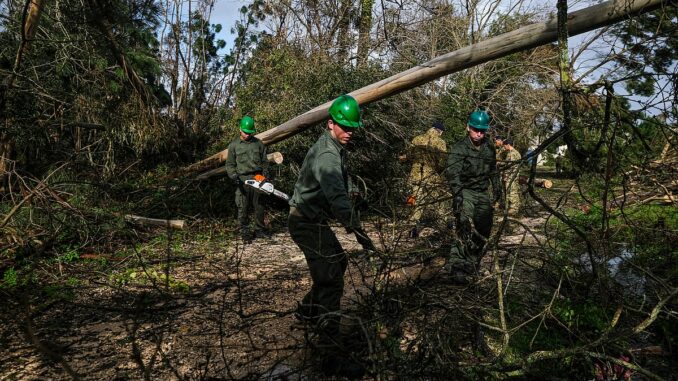
The European Commission said this Wednesday, February 18, that it was in contact with Portugal to decide which one-off expenses related to government support, after the storms, would not count towards the tight ceilings of European Union (EU) fiscal rules.
“We note that, on February 1, the Portuguese Council of Ministers approved a package of measures in response to Storm Kristin. The Commission is currently developing contacts at a technical level to analyze the nature, characteristics and budgetary costs associated with the announced measures, as well as the possible classification of the different measures as specific”, indicates an official source from the community executive in a written response this Wednesday and sent to the Lusa agency.
The response – from the institution’s spokesman for the Economy, Balazs Ujvari – comes one day after the Portuguese Government said that it had obtained approval from the European Commission for budgetary flexibility in expenditure on State support due to bad weather, so that they do not count towards compliance with community budgetary rules.
Still, the European Commission warns: “Climate-related phenomena occur with different levels of intensity in each country and each year and only the exceptional expense associated with these events should be considered as a one-off measure”.
The community institution now reminds Lusa that “the EU’s budgetary supervision framework allows exceptional events outside the Government’s control to be taken into account”, pointing out that “this has already been applied in several cases in the past, for example, with regard to forest fires in Portugal in 2017”.
“This is not about the Commission granting flexibility to Member States, but something that is part of the normal functioning of tax rules”, he says.
According to the community executive, “temporary and non-recurring expenses can be classified as specific measures – one-off -, insofar as they are directly linked to clearly exceptional events beyond the Government’s control, including natural disasters”.
Thus, “when deciding whether the associated costs should be classified as a one-off measure, the Commission analyzes whether the underlying event is truly exceptional or whether it has a recurring nature”, Balazs Ujvari tells Lusa.
The budgetary implications of these measures will now be assessed in the next Spring 2026 European Semester package, which will be released in May.
Brussels’ assessment will be based on the spring macroeconomic forecasts, which will also be released at that time, taking into account the information contained in the annual progress report to be presented by Portugal by April 30.
One-off expenditure concerns public spending with transitory budgetary effects related to the support that the Portuguese Government is granting due to bad weather and recent storms.
Initiatives such as financial support of around 2.5 billion euros are at stake to help families, companies and local authorities rebuild homes, infrastructure and productive sectors after serious damage caused by storms Kristin, Leonardo and others.
The government is moving forward with direct support for the reconstruction of houses worth up to 5,000 or 10,000 euros, aid for farmers with applications that already exceed 300 million euros and simplified ‘lay-off’ measures that guarantee salaries for workers in affected companies.
Leave a Reply