
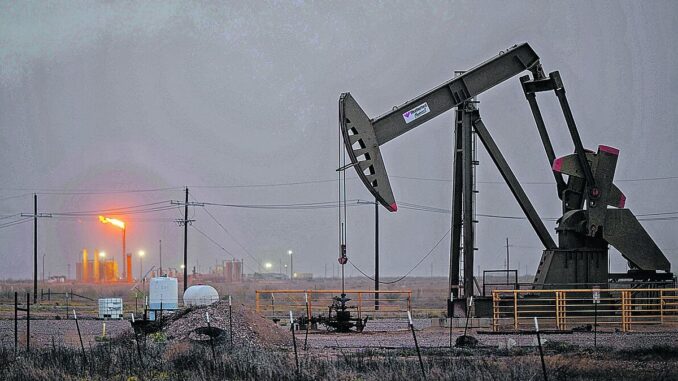
World oil production fell by 10.1 million barrels per day in March due to the war in the Middle East, the biggest drop recorded to date, the International Energy Agency (IEA) reported this Tuesday, 14th.
In its monthly report on the oil market, the IEA states that the accumulated losses caused by the conflict exceeded 360 million barrels in March and could grow to around 440 million in April, if the interruptions continue.
At the beginning of April, Iran’s near blockade of the Strait of Hormuz reduced the flow of crude oil, natural gas and refined products through that corridor to 3.8 million barrels per day, whereas in February — before hostilities — more than 20 million barrels per day passed through it.
Although countries such as Saudi Arabia, the United Arab Emirates and Iraq have opened alternative routes to transport part of their production, oil exports have suffered losses of more than 13 million barrels per day, partially offset by the use of reserves that, according to the IEA, are decreasing.
The agency revised downwards the demand outlook for 2026, now estimating an annual average of around 104.3 million barrels per day, which represents a reduction of 730 thousand barrels per day compared to the March forecast.
Between the second and fourth quarters, the drop in consumption could reach 1.5 million barrels per day — the most abrupt decline since the start of the covid-19 pandemic — and, if the disruptions persist, demand could contract by up to five million barrels per day year-on-year in that period.
The report’s authors warn that keeping disruptions high will force reserve consumption at “unsustainable” rates of around six million barrels per day, equivalent to two billion barrels over the course of the year.
The executive director of the IEA, Fatih Birol, warned that “April should be worse than March” for the energy sector and described the situation as “the most serious energy crisis in history”, stressing that the impact extends beyond oil and natural gas, also affecting essential products such as fertilizers, petrochemicals and helium.
Leave a Reply