
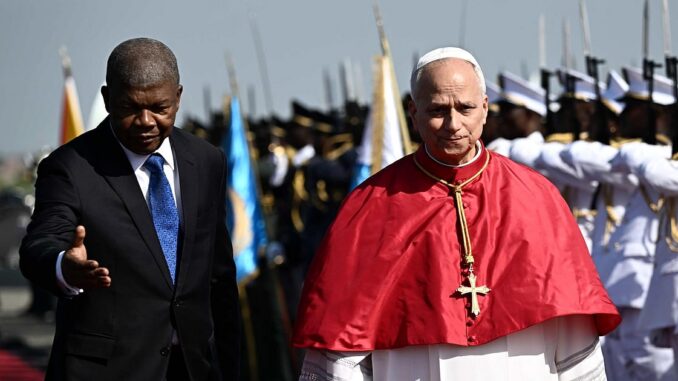
Pope Leo XIV presided this Sunday, April 19, in Luanda, at his first mass in Angolan territory, in a celebration marked by an appeal for reconciliation, social justice and the renewal of hope in the country’s future. In front of thousands of faithful gathered on the Kilamba terrace, the Pontiff focused his homily on the need to overcome old wounds that continue to mark Angolan society, arguing that only overcoming divisions, violence and corruption can pave the way for a new stage for the country.
The Pope dedicated Sunday entirely to the Angolan Catholic community, in what was also his first celebration in the first Portuguese-speaking country to receive him. The mass took place in Portuguese and had as its starting point the Gospel of the Third Sunday of Easter.
In his reflection before the faithful, Leo XIV evoked the memory of the years of civil war in Angola, associating this past of suffering with the human experience of discouragement, loss and uncertainty. “Along the way, the conversation between the two disciples, who remember with dismay what happened to their Master, brings to mind the pain that marked their country”he stated, quoted by Vatican News.
Even so, he stressed that the Christian message does not end in pain, pointing rather to the presence of the resurrected Christ as a sign of company, consolation and renewal. The Pope insisted on the importance of prayer, listening to the Word and the Eucharist as pillars of Christian life.
At the same time, he warned of the risk of religious practices that mix Christian faith with superstitious elements, defending fidelity to the Church’s teachings. “It is necessary to always be attentive to forms of traditional religiosity”, he said, warning that these “run the risk of confusing and mixing magical and superstitious elements that do not help the spiritual path”.
In a speech with a strong social dimension, Leo XIV also referred to the problems of poverty that affect the country and called for a Church closer to the population, capable of listening, accompanying and responding concretely to people’s suffering.
Addressing the various members of the Catholic community, from bishops and priests to missionaries, religious and lay people, the Pope highlighted the importance of commitment to others, promoting forgiveness and creating spaces of fraternity and peace.
To Angolans, he also left a clear challenge: to work for a society where the weight of past divisions gives way to a culture of justice, sharing and responsibility. “Only in this way will a future of hope be possible, especially for the many young people who have lost hope”quotes Vatican News.
In the final part of the homily, the Pontiff reinforced the idea that the country must look forward with confidence. “Today it is necessary to look to the future with hope and build hope for the future,” he declared, adding: “Do not be afraid to do so.” At the end of the celebration, Leo XIV assured his spiritual closeness to the Angolan people and entrusted the faithful to the protection of Our Lady of Muxima.
Call for hope, dialogue and justice
The visit of Leo XIV, on a tour of Africa, began on Saturday, April 18, the first official acts of his apostolic visit to Angola, the third stage of the trip he is undertaking across the African continent. The agenda began at the Presidential Palace, with a courtesy visit to the President of the Republic, João Lourenço, followed by a meeting with authorities, representatives of civil society and members of the diplomatic corps.
In his first speech in Portuguese since arriving in the country, the Pontiff stated that he was traveling to Angola with the spirit of a pilgrim. “I come to you as a pilgrim to this land that God loves”he declared, thanking the Angolan authorities for the invitation and the welcoming words addressed to him.
Before addressing the central themes of the intervention, Leão XIV expressed solidarity with the populations affected by the intense rains and floods in the province of Benguela, leaving a word of closeness to the families who lost their homes.
According to Vatican News, the Pope highlighted in his speech what he considered to be the deep riches of the Angolan people, stressing that there are values that cannot be bought or stolen. Among them, he pointed out the ability to maintain joy even in difficult contexts, seeing this attitude as a sign of moral and spiritual resistance.
Leo XIV also presented Africa as a reserve of hope for the world, sustained to a large extent by the energy of young people and the resilience of the poorest. In his reading, these sectors of society continue to dream, hope and assume responsibilities, even in adverse contexts.
“A very colorful mosaic”, he said, referring to Angola, defending diversity as wealth and not as an obstacle. In this sense, he appealed to political and social leaders not to fear differences, not to silence the projects of young people, and not to underestimate the experience of older people.
Leo XIV did not forget the warning about the effects of economic models marked by the exploitation of resources and exclusion. The Pontiff spoke of the suffering caused by interests dominating material wealth, associating this logic with deaths, social imbalances and environmental damage.
For the Pope, the response to these wounds involves “encounter and dialogue”: only with openness to others will it be possible to overcome tensions, rivalries and divisions that weaken the social and political fabric. “Without each other there is no justice”he stated, in one of the strongest passages of the speech.
Leo XIV further maintained that joy and hope should not only be seen as personal dispositions, but also as forces with an impact on collective life. “Joy knows how to trace trajectories even in the darkest regions of stagnation and anguish”, he said, adding that “without joy there is no renewal; without interiority there is no liberation; without encounter there is no politics”.
In the final part of the intervention, the Pontiff recalled that Angola can become a true project of hope, as long as it mobilizes its living forces in favor of the common good. He also highlighted the role of the Catholic Church, which he said wanted to contribute to a more just coexistence, free from new forms of slavery and false promises of happiness.
In conclusion, the Pope entrusted Angola “to divine protection”. “May God bless Angola.”
On Monday, April 20, Leo XIV travels to Saurimo, in the east of the country, to visit a home for the elderly (9:45 am) and preside at the Eucharist (11:15 am), returning to Luanda in the late afternoon for a meeting with the bishops and pastoral workers, at the Parish of Nossa Senhora de Fátima (5:30 pm).
The last stage of the apostolic journey begins on April 21st, with departure from Luanda to Equatorial Guinea, at 9:15 am.
Leo
Leave a Reply