
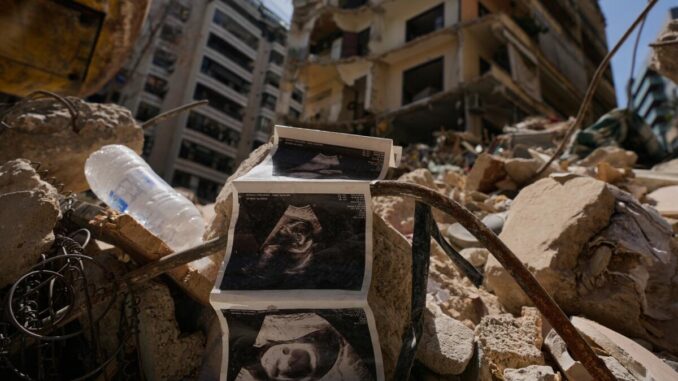
WASHINGTON.- A 10-day ceasefire began in Lebanonin an attempt to stop the clashes between Israel and the militia of Hezbollaha conflict whose current balance is thousands of victims and regional tensions.
The agreement, announced by the president of the United States, Donald Trumpalso seeks to promote broader negotiations that involve Iran.
Although the announcement was presented as a ceasefire between Israel and Lebanon, the reality is that the clashes have been mainly between the Israeli army and Hezbollah, a group that did not formally participate in the agreement.
There is still uncertainty about the truce because Hezbollah did not participate in the agreement.
The ceasefire began at midnight (GMT+3) on Friday, April 17.
10-day ceasefire begins in Lebanon and Israel
The cessation of hostilities came into force after a series of diplomatic negotiations promoted by USA. However, the agreement establishes specific conditions that leave open the possibility of new tensions in the region.
According to him US State DepartmentIsrael maintains the right to defend itself “at any time, against planned, imminent or ongoing attacks.”
This implies that, although it will not carry out offensive operations, it does not give up responding militarily.
For his part, the Israeli Prime Minister, Benjamin Netanyahustated that he accepted the truce “to boost” peace efforts, but made it clear that troops will not withdraw from southern Lebanon, where they seek to establish a 10-kilometer “security zone.”
Hezbollah, meanwhile, warned that the “Israeli occupation of our land gives Lebanon and its people the right to resist it,” a position that could complicate the stability of the agreement in the coming days.
Despite the truce, tension persisted in the first hours, as the militia continued to launch rockets towards northern Israel, while warning sirens continued to be activated in border areas.
Reactions in Beirut and displacement of civilians in Lebanon
The start of the ceasefire was greeted with celebrations in Beirutwhere bursts of gunfire were heard in the air shortly after midnight (local time), a sign of relief after weeks of conflict.
In parallel, Thousands of displaced families began to return to the south of the country and to the southern suburbs of the capital, despite official warnings to wait until the stability of the truce is confirmed.
The war caused displacement of approximately one million people in Lebanonbut there is still uncertainty about when they will be able to safely return to their homes.
Authorities insisted that the return must be gradual, as the situation on the ground remains volatile and there are no guarantees that the ceasefire will hold.
In addition, damage to infrastructure and residential areas complicates the immediate return of the population affected by the clashes.
What was the role of the United States, Pakistan and Iran in the conflict and temporary truce?
The ceasefire agreement is the result of intense diplomatic activity led by the United States. According to the White Housemeetings were held in Washington between representatives of Israel and Lebanon, followed by calls between Trump and regional leaders.
The Secretary of State, Marco Rubioparticipated in the efforts by communicating with the Lebanese president, Joseph Aounwho supported the truce.
Furthermore, it was reported that the mediation included Pakistana country that has played a key role in talks between the United States and Iran, in an attempt to extend the ceasefire at the regional level.
Trump even invited the leaders of both countries to the White House for what he called “the first meaningful talks” since 1983, seeking to move toward a broader agreement.
However, Hezbollah had previously rejected any direct dialogue between Lebanon and Israel, adding an element of complexity to the negotiations.
Impact of the US-Iran war on the Middle East
The ceasefire in Lebanon occurs amid a broader war involving the United States, Iran and Israel, with global economic and geopolitical repercussions.
This conflict has left at least 3,000 dead in Iran, more than 2,100 in Lebanon, 23 in Israel and additional victims in Persian Gulf countries, in addition to US military deaths.
One of the critical points is the control of the Strait of Hormuza route through which nearly 20% of the world’s oil travels. Its closure by Iran has caused volatility in energy markets and increased prices.
Although oil prices have recently shown a slight drop due to the expectation of a truce, the situation remains uncertain.
Regional officials said the United States and Iran could have an “agreement in principle” to extend the ceasefire, although disagreements remain on key issues such as Iran’s nuclear program and compensation for war damages.
Despite the start of the truce, international leaders warn that the agreement is fragile and could break if diplomatic progress is not achieved in the coming days.
The Secretary General of the UN, Antonio Guterresrecalled that attacks against civilian infrastructure are prohibited by international law, in reference to threats to intensify bombings.
For his part, Trump urged Hezbollah to behave “well and kindly” during this period, while expressing his desire to achieve lasting peace “once and for all.”
However, Iran maintains a firm stance by rejecting proposals that do not include a permanent end to the conflict, making an immediate solution difficult.
With a limited period of 10 days, the success of the ceasefire will depend on the willingness of the parties to advance in substantive negotiations, in a region marked by decades of conflict and geopolitical tensions.
With information from AP y EFE
Leave a Reply