
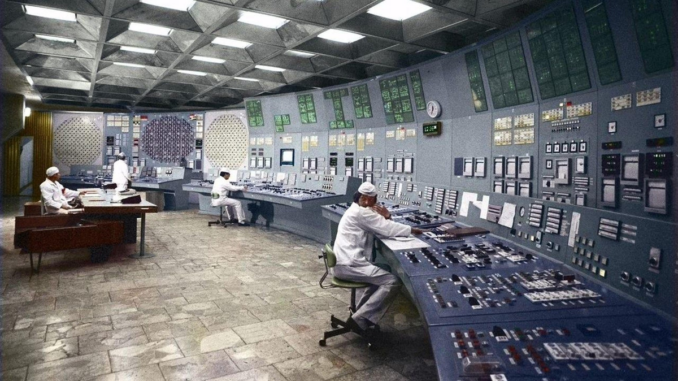
Episode 1/6. In the 1970s and 1980s, the USSR made civil nuclear power a central instrument of its energy policy. The RBMK reactor embodies this industrial ambition. It also reveals the technical and organizational constraints.
Chernobyl. The mere mention of this name immediately brings to mind one of the worst nuclear disasters the world has ever known, to years of radiation which disrupted the lives of thousands of Ukrainians and Russians, to the awareness of the dangers of the atom when it is poorly controlled and stifled by state lies.
However, before April 26, 1986, Chernobyl meant something else, the symbol of conquering modernity. This is the story we are going to tell you on the occasion of the 40th anniversary of the disaster.
At the heart of the Soviet modernization project
At the end of the 1970s, the Soviet Union made civil nuclear power a major axis of its energy policy. In a planned economy, it is then a question of supporting growth, supplying the industrial centers of the European part of the country and limiting the cost of transporting fossil resources from the East. In the analyzes of the International Atomic Energy Agency (IAEA), nuclear power is then presented as an economic, modern and strategic response, at the heart of the Soviet modernization project.
Under Leonid Brezhnev, this orientation took on a political dimension. The civil atom is associated with “developed socialism” and the ability of the Soviet system to compete technologically with the West. Since the commissioning of Obninsk in 1954, presented as the first civilian nuclear power plant, official communication has promoted the “peaceful atom”. It is based on a structural imbalance: most energy resources are found in the East, while consumption is concentrated in the European part of the Soviet Union. Nuclear power is then conceived as a means of reducing this gap.
In the 1970s and early 1980s, the civil nuclear program accelerated significantly. The IAEA says that between 1976 and 1982, about 12.5 million kilowatts were put into operation and the rate of construction almost tripled. At the congress of the Communist Party of the Soviet Union (CPSU) in 1981, the authorities set a clear objective: in the European part of the USSR, most of the electricity growth must henceforth come from nuclear and hydroelectricity. Nuclear power becomes, in fact, a pillar of the Soviet energy balance.

The program is mainly based on two sectors: WWERs, pressurized water reactors, and RBMKs, graphite-moderated pressure tube reactors. However, it is this second model which will play a central role. The RBMK, in particular, is designed to fit existing industrial capabilities. Its promoters put forward several advantages: the use of low-enriched uranium, the possibility of reloading the fuel without stopping the reactor and a construction compatible with the Soviet industrial apparatus. In the logic of planning, these characteristics must make it possible to produce more, faster and at costs deemed competitive.
The complex operation of RBMK reactors
RBMK units reach high powers and can be mass produced and they respond to a priority given to volume and compliance with plan objectives. But this efficiency is based on demanding operating conditions. The RBMK indeed presents several complex operating characteristics. Its large core and architecture make certain operating regimes more difficult to control. Subsequent analyzes will highlight several vulnerabilities: a positive vacuum coefficient – that is to say a situation where reactivity can increase during the formation of steam –, a strong heterogeneity of the core and a marked dependence on strict compliance with procedures. Clearly, these characteristics do not prevent its operation, but they condition its safety.

These technical elements are also part of a particular institutional framework. In the Soviet system, security is integrated into the administrative planning apparatus rather than being an independent function. The priority given to volumes, commissioning schedules and standardization reduces the space left for feedback. Failures tend to be interpreted as simple execution deviations rather than real design problems.

Administrative centralization thus produces contrasting effects. It allows the rapid mobilization of resources and the expansion of the fleet, but it makes the circulation of critical information and the rapid correction of anomalies more difficult. The system works, and it works at scale, but it relies on a tight balance between technical requirements and organizational constraints.
12 reactors were planned at Chernobyl
It is in this industrial and political context that the Chernobyl site fits. In 1985, the country had 46 nuclear reactors in operation, including around fifteen examples of the RBMK 1000 type. Chernobyl had four reactors built from 1970 and commissioned in 1977, 1978, 1983 and 1984. Eight others were planned before the disaster, which would have made Chernobyl the nuclear power plant most powerful in the world.

The 46 Soviet nuclear reactors in service in 1986 in any case all remain dependent on strict operating conditions and an efficient circulation of technical information. It is in this gap – still barely visible at the time – that the limits of a model are located which will come to light…
Leave a Reply