
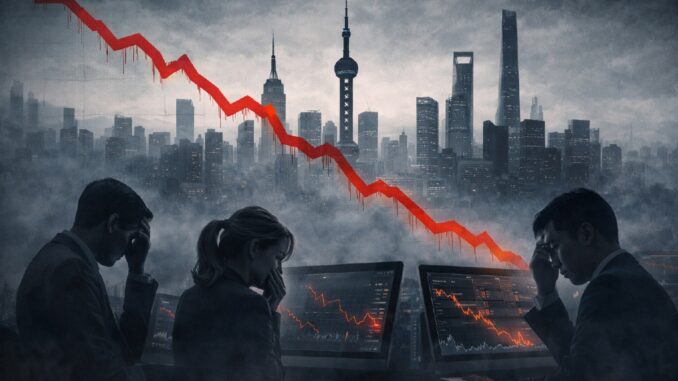

MEXICO CITY (El Universal).— A scenario of prolonged conflict in the Middle East could lead to global economy to a synchronized recession, in an environment marked by rising energy prices, inflationary pressures and a deeper slowdown in growth, according to estimates by Oxford Economics.
The analysis suggests that, under an adverse scenario in which the oil prices exceed $150 per barrel For at least four months, accompanied by shortages of refined energy products, global inflation could climb to 7.7%, a level close to that observed in 2022.
This increase would trigger non-linear effects that would amplify the economic impact and would lead to a contraction in global activity in mid-2026.
In this context, the growth of World Gross Domestic Product (GDP) would slow to 1.4% in 2026, that is, 1.2 percentage points below the base scenario, with a recovery limited to 2.1% in 2027.
According to the firm, the deterioration would be widespread, meaning They anticipate recessions in the United States and in most advanced economies, while China would reduce its expansion rate to 3.4%.
Although the impact would be less than that observed during the pandemic or the global financial crisis, the magnitude of the adjustment would imply a more coordinated decline in economic activity than any other episode in the last four decades.
The impact would not only come from rising energy prices, but also from disruptions in supply chains and tensions in financial markets.
According to the analysis of Oxford Economicsin it most critical point, towards the fourth quarter of 2026, the reduction in energy supply It would alone subtract about 0.9 percentage points from global GDP compared to the base scenario. But when incorporating additional effects such as fuel shortages and market adjustments, the total deviation would reach 2.1 points.
The impact could be even greater if additional risks materialize, such as a drop in investment in strategic sectors such as artificial intelligence or an unanchoring of inflation expectations.
It is last factor would involve a sustained increase in financing costs and would limit the ability of monetary policy to respond to future shocks. In this environment, central banks would face a complex dilemma between containing inflation or avoiding a further deterioration in economic activity, in a scenario where the energy shock threatens to prolong the weakness of global growth.
Leave a Reply