
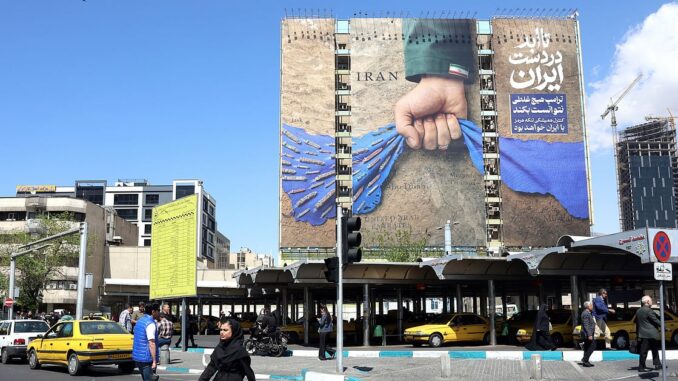
The United States had already announced an operation to clear mines in the Strait of Hormuz. And this Friday, April 17th, this is one of the points on the table of a group of more than 40 countries gathered in Paris to discuss the reopening of that maritime passage, blocked since the start of the Israeli-American attacks against Iran, on February 28th, first by Tehran and then also by the closure of Iranian ports by the USA.
Meanwhile, Iran announced the total reopening of the Strait, at least until the deadline for the ceasefire (which, if not extended, will expire on the 22nd). US President Donald Trump reacted with a “THANK YOU”, but assured that the American blockade of Iranian ships continues until there is a peace agreement. Fully open or not, one of the questions that arises has to do with the safety of the crossing, especially the presence of mines. Now If placing sea mines is quick and simple, removing them is not only time-consuming but also dangerous.
Under attack from the US and Israel, Iran decided in March to lay mines in the Strait of Hormuz, through which a fifth of the world’s supply of oil and natural gas passes. The objective was clear: to block the passage of ships that refused to pay a type of toll. It is not known how many mines were placed in that sea passage, but it is known that the Iranians changed the routes of ships crossing to avoid the mined areas. On Saturday, April 11, the Revolutionary Guards released a map of the Strait with the new safe routes – whereas before they passed through Oman, now the indication is to pass further along the Iranian coast. With its largest ships destroyed by bombing, the Revolutionary Guard resorted to smaller vessels, having even released a propaganda video showing some of the mines and ships in question.
As of April 10, o New York Times guaranteeciting US officials, that Tehran could not locate the mines it had placed in the strait and did not have the capacity to remove them.
But which mines are we talking about? According to the The GuardianIran would have deployed mainly two types: the Maham 3 and the Maham 7. Both are modern versions that no longer rely on physical contact between the ship’s hull and the detonation mechanisms, instead resorting to magnetic and acoustic sensors that detect the proximity of a ship before detonating the warheads.
The Maham 3 is a 300-kilogram fixed mine that can be used in waters up to 100 meters deep. The Maham 7 is intended for shallower waters, weighing 220 kilos and being placed on the seabed. Its conical shape was designed to avoid detection by sonar.
Although the Strait of Hormuz is just that – narrow – the mined zone covers a large area where American minesweepers would be easy targets if the conflict resumes. The best option, also according to The Guardian, is to use unmanned maritime mine detection vehicles. For this, the US can count on the Knifefish submarine minesweeper and the MCM anti-mine ship, similar to a speedboat. Another option would be to launch the AN/ASQ-235 aerial mine neutralization system (Archerfish) from an MH 60S helicopter. Controlled by the helicopter crew, it uses vehicles equipped with sonar to detect and destroy mines.
All of this equipment, despite being unmanned, nevertheless requires the presence of ships or planes nearby from which they would be controlled, leaving their crews at the mercy of possible Iranian attacks. On the 11th, two American destroyers – the USS Frank E. Petersen and the USS Michael Murphy – crossed the strait, in an operation that US Central Command said was aimed at “preparing conditions for mine clearance.”
International law stipulates that it is not permitted to use mines to block international transit in straits open to passage. However, Iran claims part of the strait as its territorial waters. Furthermore, there are overlapping international laws and claims relating to the Strait of Hormuz, a situation that is complicated by the fact that neither Iran nor the US are signatories to the 1994 United Nations Convention on the Law of the Sea.
During the Iran-Iraq War (1980-88), Iran also laid mines in the Strait of Hormuz to halt Iraqi exports.. In the so-called “Oil Tanker War”, Belgium, France, Italy, the Netherlands and the United Kingdom responded to the US call and participated in escort and demining missions. Now, the Europeans, gathered at the summit in Paris, seem willing to repeat their help.
Leave a Reply