
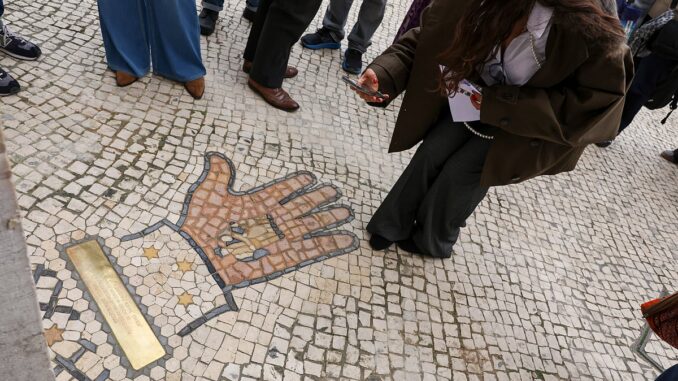
For the historian, the stone represents “a true reparation” in a country where the idea that neutrality had placed it on the sidelines of war persisted. Portugal sold wolfram to Nazi Germany, but also ceded the Lajes Base, on the island of Terceira, to the Allies. “We have to recognize the positive side: the people who survived and whose children and grandchildren are here today,” he said.
Luciano Waldman took advantage of the moment to highlight the “role of law of the Sephardim”, which allowed descendants of Sephardim to obtain nationality, which, he argues, “ended up encouraging monuments like this”.
Political and cultural commitment
The Lisbon City Council’s Culture councilor, Diogo Moura, framed the memorial as a reaffirmation of the city’s commitment to combating anti-Semitism, xenophobia and racism. He also highlighted the identity dimension of the intervention, which includes the integration of the Portuguese sidewalk – whose candidacy for UNESCO intangible heritage is in preparation – as support for the memorial. The work of municipal cobblers, described as “almost jewelry” due to its detail, inscribes European memory into the city’s fabric.
Also present, João Taborda da Gama, national coordinator of the European Strategy to Combat Anti-Semitism, highlighted the symbolism of inaugurating the memorial facing Largo de São Domingos and the church associated with the 1506 massacre, an episode of violence against Jews in 16th century Lisbon. The location, he said, articulates different historical layers: the expulsion of the Jews at the end of the 15th century, the Nazi persecution in the 20th century and the European present that seeks to confront contemporary anti-Semitism.
Luciano Waldman, Brazilian by birth, raised in Israel and residing in Portugal for more than a decade, recalled that the Jewish presence in the Peninsula predates the founding of the country itself. Figures such as the astronomer Abraão Zacuto and the mathematician Pedro Nunes left their mark on Portuguese scientific and cultural history. The first book printed in Portugal was a Jewish Bible written in Hebrew, recalls Luciano Waldman. “Jews are an intrinsic part of Portuguese society,” he added.
His biggest concern, however, lies in the attempt to dissociate this historical belonging through external conflicts. In the last two years, he reports, he has been the target of threats and vandalism, including graffiti in memory spaces such as Rua da Judiaria. For Luciano Waldman, confusing national identities with contemporary geopolitical tensions only fuels hatred.
“We really are part of society. What worries me is that people, nowadays, try to disassociate this union that has always existed between Jews and Portuguese society due to issues that happen outside of Portugal”, he concludes.
Leave a Reply