
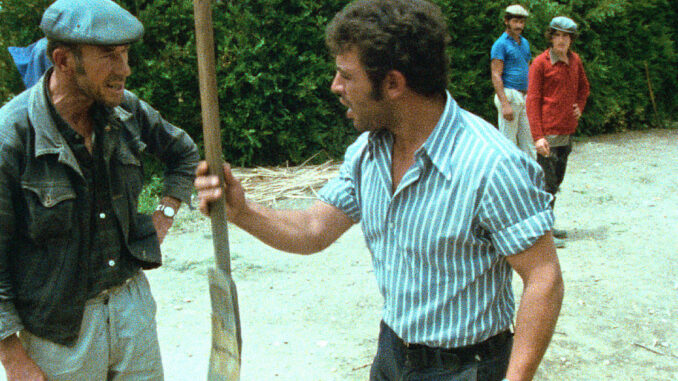
The film Torre Bela (1977), directed by German filmmaker Thomas Harlan (1929-2010) remained an unavoidable reference to the troubled times experienced after the 25th of April and, in particular, the Agrarian Reform. Its historical and symbolic value is once again the theme of a cycle at the Cinemateca, starting this Monday, April 20th, and until Friday, with a very suggestive title: “A hoe belongs to everyone”.
The title comes from an emblematic scene in the film, during the occupation of the Torre Bela property, owned by the Duke of Lafões, by peasants from the Azambuja region. The scene follows a vibrant dialogue in which a peasant protests the fact that his hoe, which he acquired, is now considered an object of the cooperative, according to a political logic that he has difficulty accepting: “(…) it is not mine, not yours, not yours, it belongs to everyone.” As written in the cycle’s introduction, “the three minutes of the ‘hoe scene’ in ‘Torre Bela’ became an almost burlesque condensation of what were the years of the Ongoing Revolutionary Process, with its mix of utopia and pragmatism.”
The film now returns in what will be its “final version”, resulting from a “fixation and restoration” process carried out based on notes left by Harlan himself. This process took place thanks to the collaboration of Cinemateca Portuguesa and Cinemateca de Munich, giving rise to a new digital copy, 112 minutes long. Its distribution will also include a DVD edition, accompanied by several extras directed by Manuel Mozos.
Torre Bela will be shown today (6pm), and it will be possible to see or review the longer version (138 minutes), in 16mm print, which Harlan prepared in 1978 for broadcast in the USA (22nd, 9:30pm). The counterpoint is important to understand that this is a film that, over the decades, has had more than a dozen versions. This “plurality” ambiguously contaminates the film’s own narrative identity which, in truth, was born from an intrinsic ambiguity, since Harlan, although not leading the revolted peasants, in fact asserted the power of the means of cinema as the “engine” of the occupation of the property — and, to that extent, of its staging. All of this is at the heart of the documentary ‘Linha Vermelha’ (2012), by José Filipe Costa, the result of an investigation into the filming of ‘Torre Bela’, which will be presented in a session (23rd, 7pm) that also includes materials from an interview with Harlan, carried out by Sérgio Tréfaut, in 1998, for his film Another Country.
The cycle is completed with several sessions that help to frame, not just the film Torre Belabut also the context in which it was born and the stories of its protagonists. Thus, for example, ‘Wundkanal’ (1984), also by Thomas Harlan, will be shown (21st, 7pm), one of the examples of his work in exposing and analyzing the crimes of Nazism — it is worth remembering that his father, Veit Harlan (1899-1964) was a collaborator of Adolf Hitler, having made the Nazi propaganda film The Jew Süss (1940). The occupation of Torre Bela It will also be remembered through documentary records from 1975 (24th, 7:30 pm), resulting from work by RTP, the cooperative Cinequanon (under the direction of Luís Galvão Teles) and the amateur director Vítor Silva.
The cycle also proposes three conversations, the first about Thomas Harlan, with his son, Chester Harlan, and Stefan Drössler, director of the Munich archive (21st); Roberto Perpignani, assembler of Torre Belawill be present to talk, precisely, about the editing of the film, in the company of José Manuel Costa, previous director of the Cinemateca (the 22nd); Finally, the production of Torre Bela will be analyzed by José Filipe Costa and Manuel Mozos (24th) — all these sessions will start at 5:30 pm. We are, after all, faced with crossed and contrasted memories in which the occupation of Torre Bela takes us into a labyrinth of films and memories where the political upheavals of the 20th century echo.
Leave a Reply