
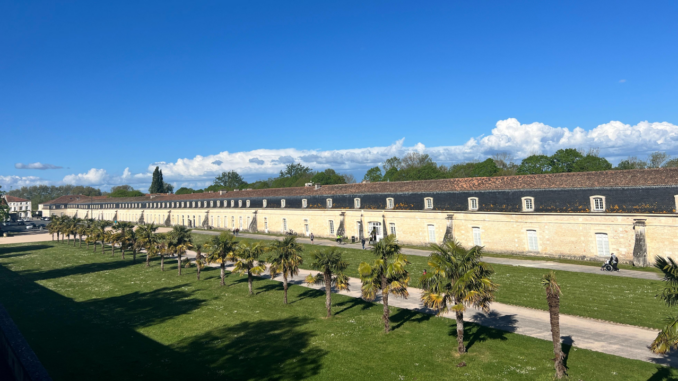
In Charente-Maritime, Rochefort Océan reveals a unique face of the Atlantic coast. Between the still visible royal arsenal, preserved estuary, islands accessible to the rhythm of the tides and gourmet addresses, it offers complete immersion, far from the hustle and bustle of the major neighboring destinations.
Rochefort does not just tell its past, it shows it. In the 17th century, under the leadership of Louis XIV, the arsenal transformed the city into a nerve center for shipbuilding. Even today, the whole remains readable.
At the National Maritime Museum, Charlotte Drahé, administrator, summarizes: “Rochefort is one of the only sites where we can still see a period arsenal in its entirety. » Models, tools and stories reveal the organization of a precise industrial system, from which the frigate notably departed “The Medusa” best known for its shipwreck
A living arsenal, between memory and engineering
The Corderie Royale is one of its strongest symbols. On nearly 374 meters, the ropes for the fleet were manufactured there. “To obtain a rope, the steps were numerous and very painful,” explains Virginie Canizares, cultural mediator. From hemp sometimes imported from Riga to hand spinning, each step required considerable labor. Today, this manufacturing no longer exists in Rochefort. It continues in only three sites in France, in a mechanized and industrialized manner.
A few minutes away, the Martrou transporter bridge extends this technical memory. Designed by Ferdinand Arnodin and inaugurated in 1900, it offered an alternative to the ferry, then the only way to cross the Charente – but subject to the vagaries of the river and the tides. “Before the transporter bridge, crossing the Charente was a big deal,” recalls Mallory Mathurin, head of the tourist operations department. Today it is one of the rare transporter bridges still in service in the world. The crossing, slow, almost suspended in the landscape, lasts around five minutes. On the other side, the Maison du ferry offers an interpretation space to understand its functioning and its history.
An estuary, between nature and stories of inhabitants
Around Rochefort, nature is obvious. In the Moëze-Oléron nature reserve, more than 6,700 hectares of marshes and polders make up an open landscape. Mélanie, nature guide and member of the LPO, guides visitors, binoculars in hand. “It’s one of the first shorebird ringing sites in France,” she explains. Between migratory birds and black-headed sheep which participate in the natural maintenance of spaces, the balance is subtle.
On the estuary, squares punctuate the landscape. These fishing huts on stilts tell a different rhythm. Christian, a retired SNCF employee, has had one for six years. “I always wanted it,” he confides. There is mullet, bass and shrimp fishing, depending on the tides.
Further away, Île Madame offers a rare break. Accessible at low tide, it is home to a family farm, the Madame Island aquaculture farm. “Our family has been here since 1955,” says Jean-Philippe Mineau. Oysters, samphire, mustard, sheep farming, everything is produced on site. “It’s not a museum under a dome. » You can also eat there, around plates of oysters, mutton chipolatas or samphire soup, in a simple and authentic setting.
A sweet life on a human scale
Rochefort seduces with its peaceful atmosphere. On Place Colbert, lined with cafés, the city comes to life slowly. The setting, immortalized by the film “ The Young Ladies of Rochefort » by Jacques Demy, retains an elegance made of light stones and open perspectives.
Avenue Charles-de-Gaulle leads towards the arsenal, crossing a famous market. Here, far from the hustle and bustle, the city assumes its rhythm.
On the sea side, to reach Fort Boyard and the island of Aix, excursions leave from Fouras-les-Bains. This is why the famous television program born in 1990 gave its name to the character of “Father Fouras”, an emblematic figure of the game. A fun way to approach the maritime history of the territory.
Finally, in Rochefort, we take the time to sit down at the table. In the building Living[s]historic building, former food store, the Ripaille restaurant offers generous cuisine. Very tender grilled octopus, caramelized gratin dauphinois, elaborate profiterole, all in a friendly atmosphere and with particularly attentive service. The place is run by chef Grégory Coutanceau and his family.
Practical Notebook
Where to sleep
Where to eat
- Ripaille – Vivre(s) building, 63 avenue Charles de Gaulle, 17300 Rochefort
- Le Bistrot du Coin, 81 ter boulevard des Deux Ports, 17450 Fouras
What to do
- Royal Corderierue Jean-Baptiste Audebert, 17300 Rochefort
- National Maritime Museum1 place de la Gallissonnière, 17300 Rochefort
- House of Pierre Loti137 rue Pierre Loti, 17300 Rochefort
- Ferry Bridge and Ferry Houseavenue Jacques Demy, 17300 Rochefort
- Accro-Mâts (arsenal maritime), Arsenal des mers, 17300 Rochefort
- Maritime excursions Fort Boyard and Aix Islanddeparture from the port of Fouras-les-Bains
- Rochefort market, Place Colbert and city center, Tuesday, Thursday and Saturday.
How to get there
- TGV to Surgères then bus to Rochefort
- Or train to La Rochelle then TER
What to bring
- Salt, mustard and products from Isle Madame
- Oysters and estuary specialties
S’informer
Leave a Reply