
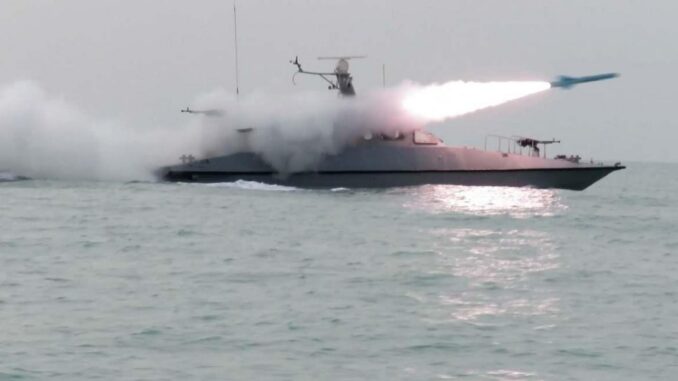
One of the hot spots in the Iran war is he Strait of Hormuz. The naval passage that the ayatollahs control and with which they play to put pressure on Trump and the world economy.
Iran has once again closed this strait guarded by a “mosquito fleet“until the American president lifts his own veto on Iran’s maritime trade.
Thus control of Hormuz has become a powerful bargaining chip against the United States.
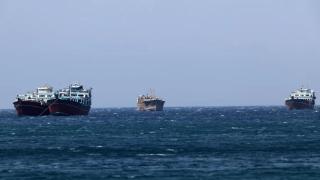
The longer it is closed, the more it hits the world economy due to the pressure of not passing materials such as gas or oil. Something that undoubtedly triggers inflation.
A peculiar naval force
Iran guards the Strait of Hormuz and does so in a peculiar way. Its main defense force is the “mosquito fleet” that it uses to maintain tight maritime control.
Its name is peculiar and so is its strategy. The ayatollahs maintain their threat with a flotilla of small boats, fast and agile that are designed to besiege maritime trade.
This flotilla is the core of the Islamic Revolutionary Guard Corps’ naval forces. An independent arm of this country’s navy.
Although it is true that it is not the only country that uses them. Russia and its navy, after the fall of the USSR, have tried to maintain its naval industry with this type of mosquito fleets.
Historically, this type of fleet is a solution in an unstable period for those countries that could not afford an oceanic navy of a certain size.
However, the evolution of technology and design based on particular needs makes this type of boats effective in a maritime war scenario.
Furthermore, these types of ships are too small, which prevents them from appearing in satellite images, something that gives them an advantage in this field.
But, not only that, they are usually moored in docks with deep caves dug into rocky shores.
This prevents them from being seen and can be deployed in a matter of minutes directly to attack the approaching enemy.
Therefore, this poses an enormous threat to the ships that usually frequent the Strait of Hormuz and also the Gulf, since they can be surprised without suspecting the presence of these ships in the area.
In fact, this Strait is a passage of 33 kilometers wide and is susceptible to ambushes at sea, but also land attacks from the Iranian islands.
Main threat in Hormuz
These mosquito fleets have been one of the main threats by the Islamic Republic to the United States Navy.
The main threat that these vessels harbor is their ability to launch missiles and drones from them towards the enemy.
Due to this capacity, although they are small, they are capable of destroying both commercial and US military ships.
“The Islamic Revolutionary Guard Corps navy functions more like a guerrilla force at sea“, explica Saeid Golkara political science professor at the University of Tennessee, told the New York Times.
A tactic that is based on “lightning attacks“instead of resorting to classic naval battles with”large warships“.
This comes as the ayatollahs focus on “asymmetric warfare” in both the Persian Gulf and the Strait of Hormuz.
20 vessels attacked
The Iranians have taken control of this part of key maritime space in order to put pressure on their enemies, both Israel and the United States, in war.
To date it is estimated that the Revolutionary Guard Navy has attacked some 20 boats. This is stated by the United Nations International Maritime Agency.
However, despite being attacks provoked by the Iranian regime, they do not usually claim responsibility for these attacks.
This is part of their strategy because, according to experts, these types of attacks would not come directly from the ships that make up the mosquito fleet, but would surely be launched from other land platforms.
Thus, they manage to mislead and evade the enemy with attacks from boats and from key points on land near the seasomething that prevents these attacks from being traced in a simple way.
The origin of the strategy
The Revolutionary Guard Navy joined the ground forces in 1986.
At that time, Iran was aware that it could not fight the United States, so it divided the army into sectors and developed a maritime military capability to try to harass ships in the gulf.
The country began using vessels equipped with grenade launchers or machine guns and has since built a range of small ships designed as miniature submarines and marine drones.
A strategy that has allowed it to acquire a mosquito fleet capable of besieging the enemy in a maritime scenario.
Something that gives you an advantage and allows you to have a negotiating position vis-à-vis the United States by being able to use it to block the Strait of Hormuz.
Leave a Reply