
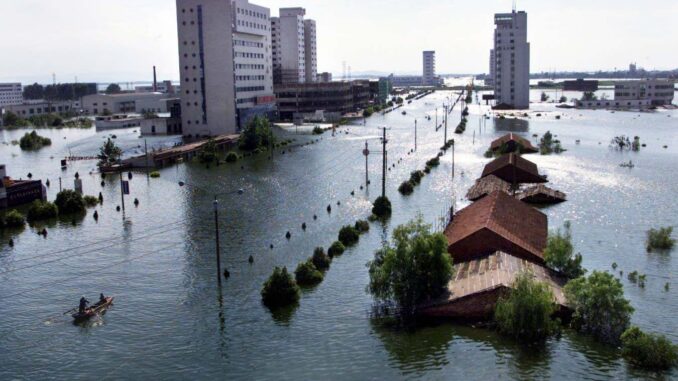
Super El Niño led to flooding in China in 1998
ROBYN BECK/AFP via Getty Images
Last month, weather models began to show that a very strong El Niño climate phase, potentially the strongest we’ve ever seen, could develop later this year.
Many call it a “super El Niño” or even a “Godzilla El Niño.” It could bring drought to some areas of the world, floods to others, and set the planet up for the hottest year on record.
“The forecast from now is that the tropical Pacific is warming faster than at any other time this century,” he says Adam Scaife at the Met Office, the UK’s national weather service. “So something unusual is going on.
What is Super El Niño?
El Niño is a natural climate pattern that raises temperatures and disrupts weather around the world. This usually occurs when the trade winds blowing from east to west across the tropical Pacific weaken, reducing the upwelling of deep cold water and allowing warm surface water to flow back across the central and eastern Pacific. Atmospheric circulation gradually shifts to the east.
El Niño begins when sea surface temperatures in the central Pacific reach 0.5°C above the long-term average. If they reach 2°C or more above the long-term average, it is a very strong or “super” El Niño.
Peruvian fishermen noticed that the warming tends to peak in December, so they named it El Niño after the Christ child.
While El Niño happens every few years, super events only occurred in 1982-83, 1997-98 and 2015-16.
How likely is this to happen?
A burst of westerly winds in March and early April swept huge amounts of warm water into the central and eastern Pacific, setting the stage for a strong or very strong El Niño. Met Office models project the temperature anomaly there will approach 2°C by September, and a group of models run by the European Center for Medium-Range Weather Forecasts (ECMWF) gives about a 50 percent chance of reaching a 2.5°C anomaly by October.
The U.S. National Weather Service has predicted a 25 percent chance of a super El Niño by the end of the year. If two of the models in the European group are projection Central Pacific temperature anomalies above 3°C by September will prove correct, then that will be it the strongest El Niño has ever been observed.
But signs of a developing El Niño are still weak at this point, and models struggle to make accurate predictions, a phenomenon known as the “spring predictability barrier.” Meteorologists will have a better idea of the strength of the upcoming El Niño in May or June.
What are the effects on the weather?
Changes in the atmospheric circulation over the central and eastern Pacific propagate over long distances.long distance connections“, changing weather patterns around the world. This can lead to impacts such as crop failures, coral bleaching and the spread of disease, causing billions of pounds worth of damage.
“Things are upset, they’re out of whack,” he says Tim Stockdale at ECMWF. “It’s not necessarily that there’s more storms, let’s say rainfall… It’s just happening in places that don’t normally get it.”
El Niño typically brings stormier, wetter weather to the southern coasts of North and South America, the Horn of Africa and China, increasing the risk of flooding.
At the same time, hot and dry weather typically hits places like Australia and Southeast Asia, central and southern Africa, India, and the Amazon rainforest, increasing the risk of drought, heat waves, and wildfires.
The effects are more complex in the UK and North West Europe. There, El Niño can increase the chances of warmer summers and cooler winters, but it can also bring wet, mild winters, depending on what other climate patterns are doing.
The catastrophic consequences may continue even after El Niño has peaked. In the summer following the super El Niño of 1997-98, heavy rainfall and floods in China’s densely populated Yangtze River Valley killed 3,000 people destroyed 15 million homes and caused economic losses of $20 billion.
One piece of good news is that fewer hurricanes form off the Caribbean and US East Coast during El Niño. The enhanced atmospheric circulation results in greater wind shear, so these storms tend to dissipate quickly rather than gradually developing into huge hurricanes.
How will it affect the climate?
If climate change is like a tide that gradually increases temperatures, then El Niño is like a giant wave that temporarily makes them even stronger. A strong event could raise global temperatures by 0.2°C.
The last El Niño occurred in 2024, bringing the warmest year on record, with global temperatures briefly exceeding the Paris Agreement’s 1.5°C limit for the first time. If a super El Niño develops, many think 2027 will set a new record.
“Since we’re already … close to 1.4, it’s quite likely or probable that 2027 will cross the 1.5 mark,” Scaife says. “That’s a sign. [global warming is] to get very close to the threshold of Paris.”
Will we see more super El Niño events?
Central Pacific El Niño temperatures are getting warmer due to climate change, but so is the long-term average of the temperatures they’re being compared to, so by that definition we shouldn’t see an increase in the number or strength of El Niño temperature anomalies. For this reason, the U.S. National Weather Service has begun classifying El Niño by how much warmer the central Pacific is than other parts of the tropics at present, although this new definition has yet to be adopted elsewhere.
El Niño and its cooler counterpart La Niña have become more frequent and extreme over the past 50 to 60 years. One studies proposed climate change has amplified these swings between warm and cooler temperatures in the central Pacific by 10 percent. But given that we only have about 150 years of data and our early measurements were less reliableMost scientists are still reluctant to say that climate change is overpowering El Niño.
“It’s a very tricky question, will El Niño change under climate change,” says Stockdale. “The answer is that it probably will.
It is clear that global warming is exacerbating the effects of El Niño. Increased global temperatures lead to more evaporation from the soil and more moisture being held in the atmosphere, intensifying extreme weather events such as droughts and floods.
“We call it amplifying the hydrologic cycle,” says Stockdale. “Because El Niño can cause significant changes in normal rainfall, it can be exacerbated by climate change.”
topics:
Leave a Reply