
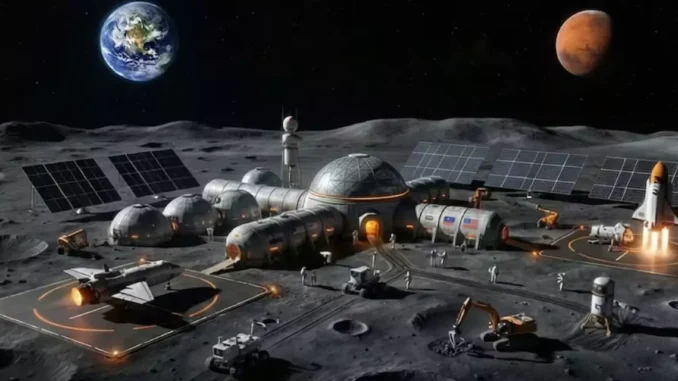
Following the success of Artemis II, NASA unveiled its most ambitious plan in decades: to establish a permanent human presence on the Moon through decades of missions and building a base on its surface.
The project, detailed in the “Moon Base User Guide,” involves up to 73 students over the next few years, with the goal of becoming operational in 2032.
A THREE-PHASE PLAN
The strategy is divided into three progressive phases. The first, with more than 20 landings, seeks to understand the technology and logistics bases before 2029. The second considers infrastructure development and frequent triple missions, while the third aims for a permanent occupation using resources from the Moon itself.
The fire is at the moon’s pole, which is thought to be key to its scientific potential and the possible presence of frozen water.
INSUFFICIENT TECHNOLOGY AND EXTREME RISKS
In light of the optimism, the document acknowledges significant limitations. The main disadvantages include imprecise Earth systems, poor energy sources, and a poor understanding of the effect of the lunar environment on the human organism.
Extreme conditions – radiation, abrasive dust and high temperatures – will force us to develop completely new technologies to guarantee the survival of astronauts.
MILLIONAIRE PRICE AND RETURN
The Artemis program exceeds $100 million and is accruing revenue ahead of its original calendar. Next, take the projected court pressure from Casa Blanca.
Each launch of the SLS system represents a multimillion-dollar investment, which has raised questions about the financial viability of the large-scale project.
GLOBAL COMPETENCE ACCELERATES THE CALENDAR
The geopolitical factor also weighs. The United States is trying to maintain its lead over China, which plans to send astronauts to the moon before 2030 and has expressed interest in the same strategic areas.
This new space career has led to accelerated decisions and partnerships with private companies such as SpaceX and Blue Origin, which are developing key systems for future missions.
FROM THE MOON TO MARS
Missions like Artemis III and Artemis IV will be key to verifying the technologies and achieving the first three-dimensional missions of this new era.
More than a satellite, NASA plans that the lunar experience will serve as a platform for future missions to Mars, including the use of nuclear power and local resources.
IN RACE AND UNCERTAINTY
While the plan represents a historic leap in space exploration, it also highlights the tension between ambition and reality. Technical deficiencies, rising costs and the plant’s international competence make it uncertain whether it will be possible to meet the schedule.
Now, the goal of a human base on the moon is still as promising as it is uncertain.
Leave a Reply