
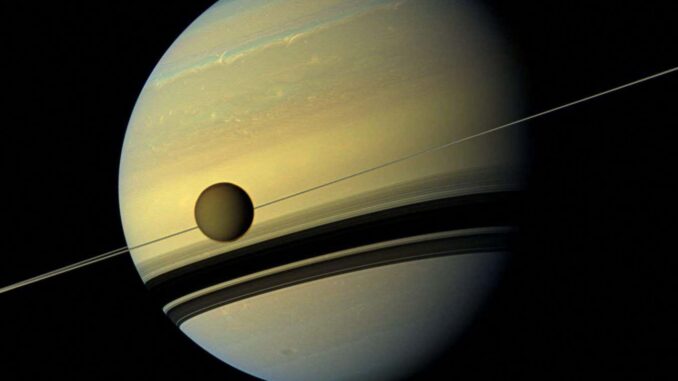
Titan, Saturn’s largest moon, with the giant planet beyond as seen from the Cassini-Huygens spacecraft
ZUMA Press, Inc./Alamy
The story of Saturn, its rings and moons, may have started with its largest moon, Titan. A collision between an early proto-Titan and a smaller object about 400 million years ago may have set in motion a series of events that created Saturn’s iconic rings and changed both the planet’s wobble and the orbits of its moons.
The Saturn system is shrouded in mystery. Its rings appear to be younger than expected, the planet’s wobble is not linked to Neptune’s motion as simulations suggested it should be, and its small moon Iapetus has a strangely tilted orbit. Titan itself has strangely few craters and an oval or eccentric orbit.
The giant collision that created the Titan we see today could explain all of these features. “It’s kind of a big unified theory that covers all the major issues,” he says Matija Ćuk at the SETI Institute in California, who led the research team behind the work. “We had some ideas about each of them, but it could be how they relate in one story that can be tested.
It begins with a predicted additional moon called Chrysalis in the outer regions of the system, which was proposed in 2022 to explain how the separation of Saturn’s wobble from Neptune’s occurred. The idea was that Chrysalis was thrown towards Saturn and disintegrated to form rings, destabilizing the wobble of Saturn and the orbit of Iapetus. However, Ćuk and his colleagues noticed that in the simulations, the most likely outcome was for Chrysalis to collide with Titan.
This is a problem, says Ćuk. “If there was a collision with Titan, it couldn’t have become rings. So he and his team began to calculate what would happen if Chrysalis crashed into Titan. They found that such a collision about 400 million years ago would have obliterated Titan’s craters and shifted its then-circular orbit into an elliptical shape, creating a shower of debris. The smaller moon Hyperion could be a piece of this debris, which would explain why it is so much younger than Saturn’s other moons.
Then, over time, Titan’s changing orbit would have destabilized the small inner moons, sending them crashing into each other and smashing each other into the tiny particles that now make up Saturn’s rings. “It all starts on Titan and then trickles down to a second catastrophe in the inner system,” says Ćuk.
“If the Titan 1.0 collision can explain many other things about the Saturn system, then I think that would really center Titan as a key element of how we see the system today,” he says. Sarah Horst at Johns Hopkins University in Maryland. “I appreciate the elegance of how many Saturn system problems it would solve at once.
The evidence that could confirm or rule out this scenario is not very far. NASA’s Dragonfly mission, scheduled to launch in 2028 and arrive at Titan in 2034, will take a close look at Titan’s surface, which should help determine whether it has indeed merged with Chrysalis. If so, we may finally understand some of Saturn’s many quirks.
topics:
Leave a Reply