
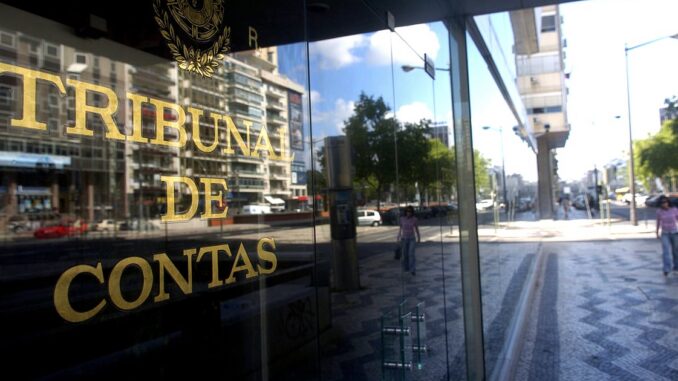
Court of Auditors says it “does not make political decisions and does not replace the political decision-maker”
The president of the Court of Auditors considers that the discussion on the reform of the prior visa is distorted and, in response to criticism from the Government, states that the institution does not make political decisions, nor does it replace the political decision-maker.
In an interview with Lusa in reaction to recent statements by the Deputy Minister of State Reform, Gonçalo Matias, the president of the Court of Auditors (TdC), Filipa Urbano Calvão, clarifies that the supervision carried out by the court – in the prior, concomitant and successive control – is carried out within the powers that the Constitution grants it, and there is “no interference with the political decision”.
“The court does not make political decisions and does not replace the political decision-maker”he states, adding that the TdC’s activity “does not constitute any obstacle to either economic development or public investment”.
The position comes after, last week, Gonçalo Matias accused the supreme body that monitors the legality of public expenses of “meddling in functions that are administrative and political”.
On two separate occasions, the minister criticized the TCU’s performance, saying, on February 25, that the institution “performs a function that is not its own”, and accusing it, on February 27, of wanting to legislate and govern in a “violation of the separation of powers”.
The Government wants to review the Court of Auditors Organization Law, the Administrative Procedure Code and the Public Contracts Code, to change the rules for applying the prior visa.
For the president of the TdC, the debate is “being tainted by some mistakes that need to be clarified”, whether about the principle of separation of powers, or about the “distinction between what is a political decision and what is an administrative decision”.
Filipa Urbano Calvão outright refuses the accusation that the court violates the separation of powers, remembering that, according to the Constitution, whoever oversees public financial management is an external body independent of political power.
Regarding the last point, he states that there is “great confusion” about the concepts in question. Intending to clarify them, he gives as an example the case of building an airport or a bridge to clarify that the political decision corresponds to the decision to build the infrastructure and determine the budget, and that the rest of the procedure corresponds to the administrative decision.
“What the Court will do is monitor these rules that have financial relevance to ensure that the expenditure is carried out in accordance with the law. Political decision is one thing, administrative decision is another”he explains.
Urbano Calvão also highlights that the Court “is open to a review of the law” and emphasizes that rethinking the financial management control model implies taking the Constitution as a starting point.
“In other parts of Europe, this model of prior inspection has already been replaced by successive inspection and greater accountability of public managers. But the issue is that when prior control is eliminated, whether judicial or administrative, [essa ausência] has to be compensated by a reinforcement of what, in the English expression, is called accountability”.
For Filipa Urbano Calvão, this implies a restructuring “of the public administration itself, which is what was done in other countries, for example, in Belgium”.
There, prior inspection was only abolished after “managing to restructure public administration and strengthen internal control systems within each public administration body”, he says.
Asked whether the Portuguese public administration is sufficiently mature to eliminate the prior visa, Filipa Urbano Calvão understands that “it is not”, saying that for decades “it has been lacking in terms of resources”.
Leave a Reply