
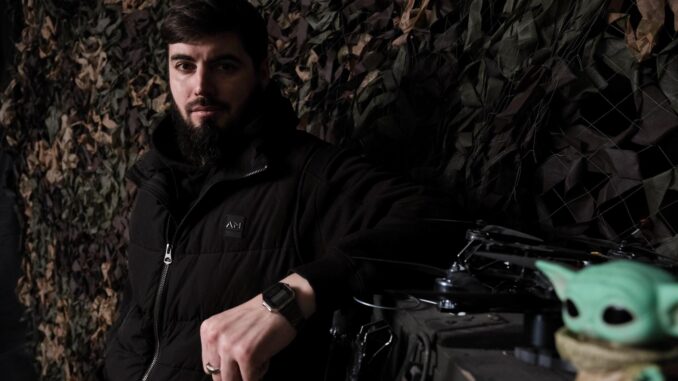
His nom de guerre is Achilles and under his direct command there is a battalion of 3,000 troopswhich later this year will become the first combat drone brigade in the Ukrainian Army.
His real name is Yuriy Fedorenkoand before February 24, 2022 he was only a councilor of the kyiv city council.
And politician with a local profile and without military experiencewho did not hesitate to enlist on the first day of the invasion as a volunteer with the Territorial Defense – paramilitary units made up of Ukrainian civilians, almost without weapons, but willing to defend their home.
“They placed us on the line of contact without artillery, without ammunition, without anything. Our most fearsome weapon was an RPG“, he remembers about those first moments.
But when Achilles ordered one of his men to put a civilian Mavic drone in the sky, to try to see the steps of the Russian troops through its camera, the war changed for all of them. It was a commercial drone that cost a few thousand euros, but it gave them the tactical advantage to win that battle and those that followed.
Today the Achilles battalion is an international reference in the offensive use of unmanned vehicles, and its commander, one of the most respected voices on drone warfare inside and outside Ukraine.
Yuriy Fedorenko receives EL ESPAÑOL in a bunker, hidden under the asphalt of the city of Kharkiv, to talk about these unmanned vehicles, but also about the new rules of global security and the future of Europe.
Commander Achilles, Yuriy Fedorenko, during the interview with EL ESPAÑOL.
The Achilles battalion was one of the first to use commercial drones to carry out combat missions during the first moments of the large-scale invasion, in 2022. Today it is clear that you were a visionary, but how did you come to the conclusion back then that drones would be decisive on the front?
When the large-scale war began, the Achilles unit was a Territorial Defense unit made up of volunteers, of which only 5% had military experience.
There were teachers, doctors, drivers, mechanics, computer scientists. On the first day of the war we formed a rifle company, and the next day we were sent to fight in the Zhytomyr sector.
After that operation, we were transferred to the Kharkiv region and placed on the contact line. We were under the command of the 92nd Brigade, without artillery, without ammunition, without anything. Our most fearsome weapon was an RPG.
Then we asked ourselves how we could detect in advance the enemy approaching us: we had no means to intercept their radios, nor reconnaissance patrols. But we had Mavic-type commercial drones.
When we flew the first Mavic, we finally saw where exactly the enemy was: their trenches, their shelters, where the cannons were shooting at us, where the tanks were shooting at us.
With that information that we saw through the drone, we were able to destroy an enemy command vehicle, a refueling logistics hub and dismantle two concentrations of personnel.
For the first time, Ukrainian gunners saw the result of their work: they were shooting not on coordinates, but with real-time correction.
At the end of May we went a step further and started attaching ammo loads to the Mavics themselves. We thus obtained a means with both reconnaissance and attack capabilities, capable of reaching a position and eliminating an enemy soldier before he reached our line.
Thus Aquiles was born, no longer as a rifle unit, but as a rifle unit with an expanded air component.
Do you think we have already reached the peak of drone warfare evolution, or will there be more advances with unmanned vehicles?
As long as the war continues, technological development will not stop. Right now the main concern is that the contact line is 20 kilometers, in both directions; but by the end of 2026 that area will be expanded to 40 kilometers. That’s where technology points.
However, thanks to technology we have reduced the number of people needed to fight. Where before you had to place a machine gunner, you can now deploy a robot with a camouflaged turret.
If before a sapper had to mine the advance axes on foot, now aerial and ground drones do it.
Robotic medical evacuation complexes are also being developed: when we operate with them, we do not risk the driver and the combat medic. Every time we save someone’s life it is an absolute priority for us.
The rest is a race: the enemy has better fixed-wing reconnaissance aircraft, it has the Shahed, the Lancet; They also have a greater number of fiber optic drones, because they have direct access to the Chinese market.
But in Vampiro-type heavy bombers we are absolute leaders – the enemy has tried and failed – as well as in anti-aircraft defense interceptor drones, which at this moment we are ahead.
Precisely, Ukrainian interceptor drones have gone around the world as they fully entered the war in the Middle East. How do you assess the help that the Ukrainian specialists in shooting down Shahed drones are providing in the Gulf countries?
For the State of Ukraine, general global security is important. I believe that in recent years all subjects of international law have understood that, in matters of security, there is no concept of “to each his own.”
Any armed conflict that occurs anywhere in the world will have consequences for States on the other side of the globe.
Concern about global security is already a fact for many countries, and some Europeans are even considering reinstating compulsory military service. You go one step further: you are a supporter of compulsory military service for men and women. Do you think it could be implemented during the war?
It would have to be implemented gradually from now on, starting with the educational processes. And when hostilities end, organize a general system from the last years of secondary school, where a notion of what war is is explained.
And upon reaching the age of majority, immediate active preparation. Not a course and that’s it, but an annual two-week refresher in field conditions. It has to be a doctrinal document.
I explain it with an example: when a thug enters a pub where no one is armed, he can take their food, their money, their lives. Now let’s imagine that you walk into one where each customer carries a gun on his belt and knows how to use it. Is that thug going to come in? Clearly not.
In the same way, no country will directly attack another where each citizen knows how to fight at a high level and mobilization is rapid. He will have to wage war through indirect means, but not through a direct armed conflict.
If we could go back, we should have started doing this in 1995. And if we had prepared then, Russia would not have attacked in 2014 or 2022.
The formula is simple: so that your children do not fight, you have to be militarily prepared at a very high level. And their children, when they are of age, too.
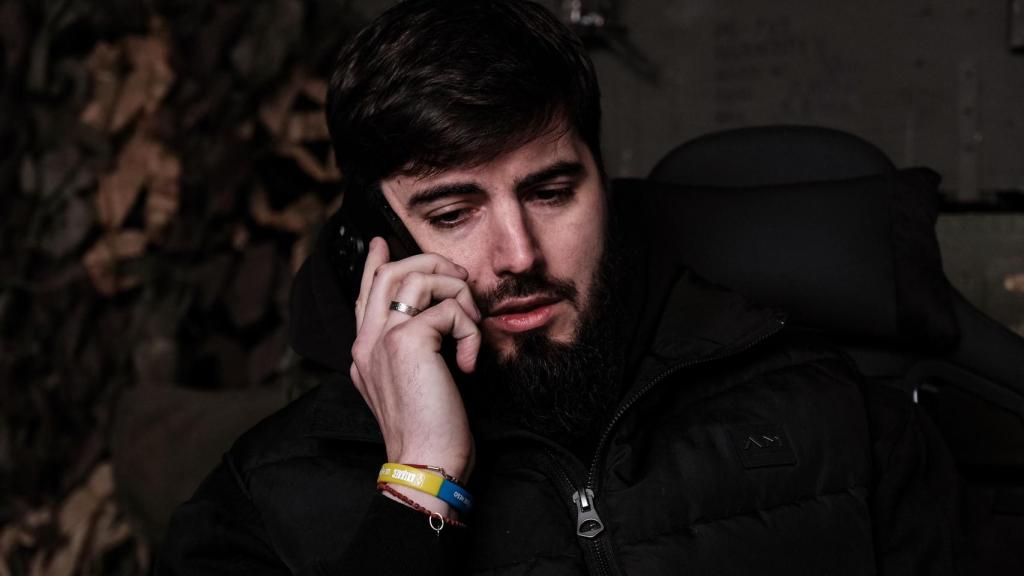
Commander Achilles, Yuriy Fedorenko, during the interview with EL ESPAÑOL.
In addition to being a soldier, you are a politician. What weighs more when it comes to making the decisions of your position, the political side or the side that wears a military uniform?
I am a politician who has fought since the first day of the large-scale war and who, as a commander, has managed to create one of the most combative units.
During a large-scale war, the military level takes first place. But although the army wins the battles, the war is always won by the people. Because the people are the ones who provide the means to fight. And war always ends through political-diplomatic means.
But in times of war, my priority is war. Once hostilities are over, I will dedicate myself to preserving the Ukrainian Army, and that can only be achieved through politics.
Returning to the war, then, one of its areas of action as a battalion is Kupiansk. A city that was under Russian occupation in 2022 was liberated after an arduous battle and was again partially occupied by Russian troops. What is the current situation in Kupiansk?
The enemy had set the objective of taking the left bank of the Oskil River before November 1, 2024, but to this day they are still unable to fulfill that mission. They have burned hundreds of armored vehicles there and sacrificed tens of thousands of lives without achieving anything.
From the other side of the river, the enemy carries out up to 50 aviation sorties a day with guided bombs, plus artillery, rockets and drones, all on our steps. But Ukrainian engineering units repair these passes, and one way or another we hold our positions.
As for the northwestern periphery, it is true that the enemy made advances, but we blocked them and drove them back. The enemy did not have real control of any neighborhood of Kupiansk.
Three months ago there were about 200 Russian soldiers inside the city, now there are less than 50. The defense forces continue daily cleaning house by house, basement by basement. And soon there will be none left.
For Russia, Kupyansk is of primarily political importance. In 2022, when they occupied it, they said: “We are here to stay.” And the defense forces expelled them. Now we have managed to stop them again.
Although at the moment the trilateral negotiations between Russia, the United States and Ukraine are paralyzed, do you believe that an agreement without Europe, and in which the Donbass is required to be given up, can come to fruition?
That’s not going to happen. The president of Ukraine cannot and does not have the constitutional right to unilaterally renounce Donbas or any other territory.
Any territorial question is resolved exclusively by referendum. And the results of that referendum seem absolutely evident to me: it is our land, the one that God gave us.
Trump has put pressure on Zelensky hard by delaying aid, financing, delaying air defense packages while the destruction of Ukraine’s energy infrastructure has multiplied.
But the cessation of hostilities will only be possible if we lose our defensive capacity or if the adversary loses its ability to attack. That is the only scenario in which real conditions for negotiating will emerge.
And the fact that Europe is not part of the negotiations is a big problem for Europe. We are not in a position to dictate conditions to President Trump, but the European countries united among themselves and within NATO should be able to present themselves with a common position before Trump.
Europe must wake up: if they provided additional financing for Ukraine, precision weapons such as Tomahawks and a military contingent on Ukrainian soil, I am sure that in a year and a half Russia could be brought to the state where it loses the ability to carry out active offensive actions.
But if this does not happen, the war will continue for a long time, I do not think it will end in 2026. And I do not understand that Europe, looking at us, does not draw conclusions.
We did not prepare intensely for a large-scale war because we believed it was not going to happen; exactly the same as Europe now. They think there won’t be a big war.
But damn, if Russia survives as a state, there will be one! And Europe will have the same problems we have now: tens of thousands of lives destroyed.
Leave a Reply