
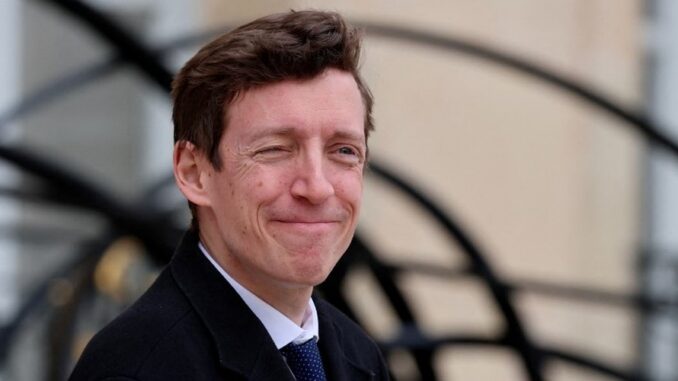
Edouard Geffray, Minister of National Education, discusses for La Dépêche du Midi the demographic decline which could make it possible to reduce the number of students per class, but also the number of teachers recruited. Interview.
Is the decline in population good or bad news in your opinion?
For the country, this is bad news. Our entire social, economic, health system, etc. is based on a demographic that can be described as dynamic, that is to say at least stable. However, we have lost 25% of births in 15 years – in 2025, there will be 25% fewer births than in 2010. This is not good collective news. Now, for National Education, the challenge is to transform this bad news into an opportunity to improve the school system and the level of our students.
The number of students per class, which has been a constant concern in recent years, will therefore be able to decrease. Is this going to be the case?
The number of students per class has already fallen substantially since 2017, and for good reason: we have lost 600,000 students and created 16,500 teaching positions at the same time. We went from 23 students per class to 21, on average, in the 1st grade. And this will of course continue.
But we remain the country in Europe where the number of students per class is the highest.
The other European countries are more likely between 19 and 19.5 students per class because they have experienced a demographic decline that began 20 or 30 years ago. To be completely reliable, we should compare France in 2025 with Italy in 1980. This is the last time that Italian women had 1.6 children per woman, like French women today.
Overstaffing is still a problem, which led Jean-Michel Blanquer to divide the CP classes in particular…
It’s true, and this reform has produced effects. If we should not make the question of numbers the alpha and omega of academic success, we must of course take advantage of the demographic opportunity to reduce the number of students per class.
Also read:
REPORTING. How the Minister of Education Édouard Geffray wants to transform 800 colleges in difficulty before the presidential election
Have you set yourself a goal?
We should be able to gradually get closer to the average of our neighboring countries over the coming years, around 19 students per class. But an average doesn’t tell the whole story, because there are places where we have 8 or 9 students per class, and other classes with 25, 26, or sometimes even 27 students. The priority is therefore both to limit class closures as much as possible, and to put staff where we still have very busy classes.
This drop in demographics is also an opportunity in budgetary terms because you will recruit fewer teachers. How many job cuts will be planned in the 2027 budget?
The 2027 budget is currently being discussed. For 2026, with a drop of almost 1.3% in the number of students, we have a drop of 0.5% in the number of teachers. In my opinion, two pitfalls must be avoided. The first consists of saying that we follow the demography perfectly, that is to say that we make a rule of three: 150,000 fewer children equals so many fewer teachers. This would amount to weakening the entire system, without reducing the number of students per class.
The other pitfall is what some people are proposing today: always recruiting so many teachers to quickly reduce the number of students per class. But if we do that, within 6 or 8 years, we will have a recruiting crisis because we will no longer need to recruit as many teachers. The idea that I defend is that of an in-between, that is to say that each year, we reduce the number of students per class, but we also accept that there may be a little fewer teachers.
You have already announced that there would be class closures. It’s not the same in big cities and in rural areas. Are you going to preserve these?
First of all, we don’t close a school without the mayor’s agreement. It is a reaffirmed commitment. Second thing, it is obvious that it does not have the same effect of closing a class in Paris and closing a class in a small rural village because on the one hand, I have a very dense educational offer, and on the other not. The third element, which is the most important in my eyes, is that we must reconnect with the idea that school is an element of territorial planning.
In the Grand-Est, the Meuse has been losing inhabitants for a century. What I hope is that we reverse the logic, starting from the needs, of what the school establishment should be on the ground, and then deducing the necessary means. It’s a real revolution. We are going to select around fifteen departments, on an experimental basis, so that local stakeholders can build their school map together, taking into account enrollment and transport constraints, in particular.
Can we say that there will always be a school less than 20 km from another village?
You don’t necessarily have to think in terms of distance, but rather overall accessibility. 20 km in the mountains can represent a considerable amount of time. We must maintain public school accessibility for all. It is precisely for this reason that we must make a commitment not to follow a purely mathematical logic on the territorial network. The subject is to continue to uphold the social contract that exists in our country, according to which the School is a local public service. If a particular school is a vital element of its territory, that means leaving it open, even if it has few students.
You said at the start of our interview that this drop was bad news for France. Emmanuel Macron had called for demographic rearmament. Can we conclude today that it is a failure?
The President of the Republic was the first to sound the alarm. We have just implemented birth leave and the plan to combat infertility, but the effects produced will not be visible for some time. Afterwards, the other element I believe in is that it is a question of collective hope. I meet people around me who tell me “I don’t want children because I don’t want them to grow up in that world”.
I want to answer: France still remains one of the most wonderful countries in the world. We have a School that is holding up, even if everything is not perfect. We are lucky to be in a country where every day, we can innovate, grow, flourish, cultivate ourselves, integrate, etc. In life, it is always better to rely on hope than on despair. And it is therefore always better to bet on the future. Those who want to have children can do so with confidence.
So perhaps one day we could have to recruit more teachers again?
This is my dearest wish: that people will have more children again if they want to, that they will be happy to have them. And behind that, we can actually start recruiting more teachers. Hence the fact, as I mentioned, that we must above all not disrupt the machine with a recruitment crisis in a few years. It is also believing in the future, and therefore in our youth.
Leave a Reply