
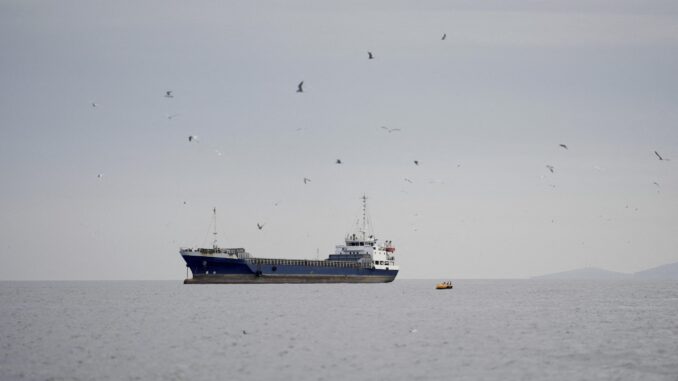
Iran announced the new closure of the Strait of Hormuz less than 24 hours after having announced its reopening, which increases uncertainty about global energy trade and negotiations with USA.
The decision was confirmed by Iranian military authorities this Saturday, although hours before they had already warned about the measure due to the US naval blockade
Central Headquarters spokesman Jatam al Anbiya, Ebrahim Zolfagaripointed out that the maritime passage is once again under “strict management and control” by the armed forces.
Tehran justified the measure as a response to the blockade imposed by the United States, which he described as a act of “piracy”.
The announcement once again calls into question the stability of one of the most important routes in the world, through which nearly 20% of global oil circulates.
A few hours after its reopening, Iran closes the Strait of Hormuz again
The new closure of the strait occurs at a key moment in the negotiations between Iran and USA to put an end to the conflict that began at the end of February.
Although the American president, Donald Trumphad celebrated the previous reopening of the route, warned that the naval blockade against ships linked to Iran will remain in force until the negotiations are completely concluded.
According to him United States Central Commandat least 23 vessels had to modify their course after the restrictions, which shows the immediate impact of the measure.
The Iranian authorities reiterated that they will not allow the normalization of maritime traffic until freedom of navigation is restored for their ships, which hardens their position against Washington.
Blow to the world economy due to the Iran-US conflict
The prior announcement of the Reopening of the strait caused a drop in oil pricesas well as adjustments in the dollar and increases in stock markets.
However, the new closure could reverse that trend when markets reopen, with possible increases in fuel costs, which have already reached high levels in recent weeks.
In addition, maritime traffic has been altered, with multiple vessels changing their routes due to the uncertainty in the area, according to reports from specialized platforms.
The volatility in crude oil prices is a reflection of the global dependence on this strategic route, especially for economies that depend on the energy supply of the Persian Gulf.
This volatility mainly affects sectors such as transportation, industry and commerce, which depend on stability in the flow of hydrocarbons.
Attacks on boats reported after closure
Hours after the closure announcement, incidents were reported in the area that further raised tension. The Maritime Operations Office of the United Kingdom reported that a tanker was attacked by boats from the Iranian Revolutionary Guard.
The attack occurred about 20 nautical miles northeast of Oman, although the crew was reported to be safe.
In addition, at least two other merchant ships reported having been shot at while trying to cross the strait, according to sources cited by Reuters.
For his part, the Iranian supreme leader, Mojtab Jameneiwarned that the country is prepared to respond to its “enemies.”
Why is the Strait of Hormuz important?
The Strait of Hormuz is considered one of the most strategic maritime routes on the planet due to its role in the transportation of hydrocarbons..
Through this corridor, delimited by Iran to the north and Oman y United Arab Emirates To the south, millions of barrels of oil and liquefied natural gas circulate daily from Gulf countries.
According to estimates of the United States Energy Information AdministrationIn 2025, about 20 million barrels per day will transit through this route, which represents an annual energy trade close to 600 billion dollars.
Its geography—just about 33 kilometers at its narrowest point—makes it a vulnerable point that can be used as a tool for geopolitical pressure.
The closure or restriction of the passage has immediate effects on international oil prices, as well as the cost of fuels and basic products globally.
Information of BBC
Leave a Reply