
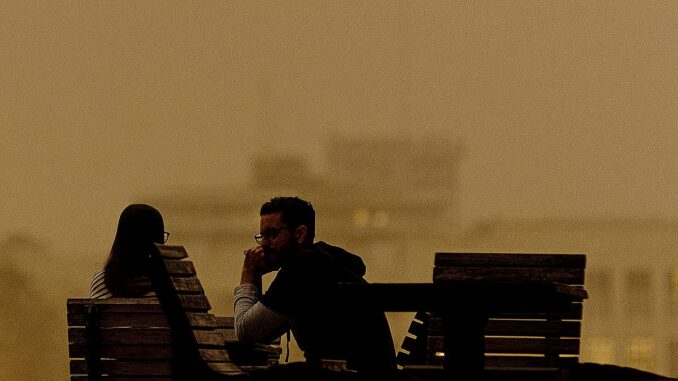
The sky has become blurrier and the air quality has worsened, but what arrives is not just “dust”. These are bioaerosols: fine particles of soil raised in arid areas of Africa that enter the atmosphere and are transported by winds to other continents. They are called aerosols because they travel in suspension and “bio” because they can carry microscopic life with them, such as viruses and bacteria.
“We are talking about soil particles that can travel thousands of kilometers and that, along the way, can transport microorganisms”, explains Ricardo Dias, professor at the Faculty of Sciences of the University of Lisbon, to DN. “That’s why, from a scientific perspective, this isn’t just a dust episode: it’s a transcontinental migration of bioaerosols.”
In this case, the available information points to an origin in the Chad region, in a region of Africa that is already quite low and prone to dust emissions. The source, highlights the expert, may be associated with a currently dry lake, rich in “exportable” minerals, material easily mobilized when there is enough wind to lift particles from the soil and inject them into the atmosphere. The arrival in Portugal, however, was less visible than in other episodes: the presence of rain and humid air favored deposition. “With humidity, rain and dust there is a co-precipitation that can be seen mainly on roofs or in cars parked on the street”, says Ricardo Dias.
The phenomenon follows different routes throughout the year, depending on wind regimes and weather conditions. “We cannot say that these events are necessarily more frequent, but we can say that the routes are becoming more diverse”, says the professor. The trajectory now observed – Chad, Canary Islands, Madeira and mainland Portugal – is seen as a deviation from a common atmospheric corridor between Africa and South America. And this corridor, recalls the researcher, has a global role: it feeds ecosystems.
“These particles are one of the main sources of matter that reaches systems like the Amazon”, notes Ricardo Dias. The scale is impressive: in certain years, the deposition associated with this dust can exceed two billion tons, the equivalent of “around 80 million truckloads of earth” in a single year. It is enough mass to influence soil fertility and nutrient balance, functioning, in many cases, as natural fertilizer.
But if there are benefits, there are also risks, especially for more vulnerable people. Fine particles can irritate the respiratory tract and worsen symptoms, and bioaerosols raise additional questions that only laboratory analysis can clarify. “Everything that has risks also has benefits. The important thing is to monitor”, argues Ricardo Dias. Therefore, the Faculty of Sciences has been monitoring these episodes since 2020 through the DUST program, evaluating the potential impact on human health, agricultural and animal production and even the biotechnological potential, that is, what can be used and learned from the microorganisms transported.
Detailed results depend on collections and tests, and only then will it be possible to know precisely what was “mixed” in the dust. “We will only have more concrete results in about a week”, anticipates the professor.
History shows that similar episodes can have unexpected consequences. In 1953, he remembers a case in which an event that began in Algeria ended up being associated, years later, with a disease that affected goat production in Alentejo. “These are connections that can only be established with time, data and tracking”, emphasizes Ricardo Dias, pointing to this example as an argument for continuous surveillance.
While the analyzes are taking place, the advice is to be cautious: avoid physical exertion outdoors, especially for those with respiratory problems.
Leave a Reply